Access
When you're forced off a GLP-1: coverage loss, shortages, and what actually happens next
Most people pushed off a GLP-1 didn't fail the drug — a formulary decision, a shortage, or a side effect pulled the trigger. In randomized trials, roughly two-thirds of lost weight returns within a year of stopping semaglutide. That's disease recurrence, not weakness — and there is an ordered set of moves to make before panic makes them for you.

The letter is four sentences long. Effective the first of the month, this medication is no longer covered under your plan. Or it’s not a letter at all — it’s a pharmacist saying the order didn’t come in again, or a clinician saying the side effects have gone from unpleasant to unacceptable. Either way, the ending arrives the same way: you didn’t choose it, it’s on a deadline, and every search result you open is either trying to scare you or sell you something.
This article is the third option. It walks the involuntary off-ramp as one path — what pulled the trigger, what your body is likely to do next and roughly when, why the panic is a predicted response rather than a character flaw, and the ordered set of moves that come before anything drastic. Every number in it comes from randomized trials, an FDA label, or regulatory text, and it is graded as it goes.
The trigger is a policy event, not a verdict
Start with the part almost no one says out loud: whether you keep access to these drugs mostly isn’t decided by how well they’re working for you. Coverage tracks the indication on the claim and the plan’s formulary — and, as of the Peterson-KFF employer data, most employer plans still don’t cover the obesity indication. Coverage for weight loss is a growing but minority benefit, and where it exists it’s increasingly hedged with restrictions. The same molecule sails through for type 2 diabetes and gets denied for weight. That’s a policy fact, not a medical judgment about you, and it’s covered in depth in our coverage-cliff explainer and cost and access evidence page.
The forced stop comes in three flavors, and they don’t call for the same first move:
| The trigger | What actually happened | The first question worth asking |
|---|---|---|
| Coverage ended or was denied | A formulary or benefit-design decision — about the plan’s economics, not your response to the drug | What exact reason does the denial letter give? (That determines which lever — exception, appeal, or plan change — applies) |
| Shortage / pharmacy can’t fill | A supply-chain event; your prescription is still valid | Is this one pharmacy, one dose form, or the molecule itself — and what does my prescriber know about current availability? |
| Side effects forced the stop | A clinical decision you and your prescriber made under duress | Is this a stop, a pause, or a switch conversation — and what’s the maintenance plan either way? |
The reason to name the trigger precisely is that your mind, under this kind of shock, collapses all three into one story: it’s over, and it was only ever the drug. Neither half of that sentence is true, and the rest of this page is the evidence.
What your body will likely do — and roughly when
Here the data is unusually good, because the withdrawal question has been probed two ways. In dedicated randomized-withdrawal trials (SURMOUNT-4 for tirzepatide, STEP 4 for semaglutide), people who had already lost weight were randomly assigned to keep the drug or switch to placebo, then watched. The STEP 1 extension is a different, complementary design: an off-treatment follow-up of trial completers after the trial ended — everyone came off the drug, and investigators tracked what happened. Read together they tell one story. Two findings, both established at the top of the evidence ladder.
In the STEP 1 extension, people who had lost a mean 17.3% of body weight after 68 weeks on semaglutide regained 11.6 percentage points in the year after stopping — about two-thirds of what they’d lost — ending a mean 5.6% below baseline (placebo: −0.1%). The share holding a clinically meaningful loss of at least 5% fell from 86.4% on the drug to 48.2% a year off it. In SURMOUNT-4, after a 36-week tirzepatide lead-in averaging 20.9% loss, the randomized halves diverged hard: continuers lost a further 5.5% to reach −25.3% from baseline at week 88, while those switched to placebo regained 14.0% to sit at −9.9% (difference 19.4 points, P<.001). Only 16.6% of the stopped group kept at least 80% of their lead-in loss, versus 89.5% of continuers.
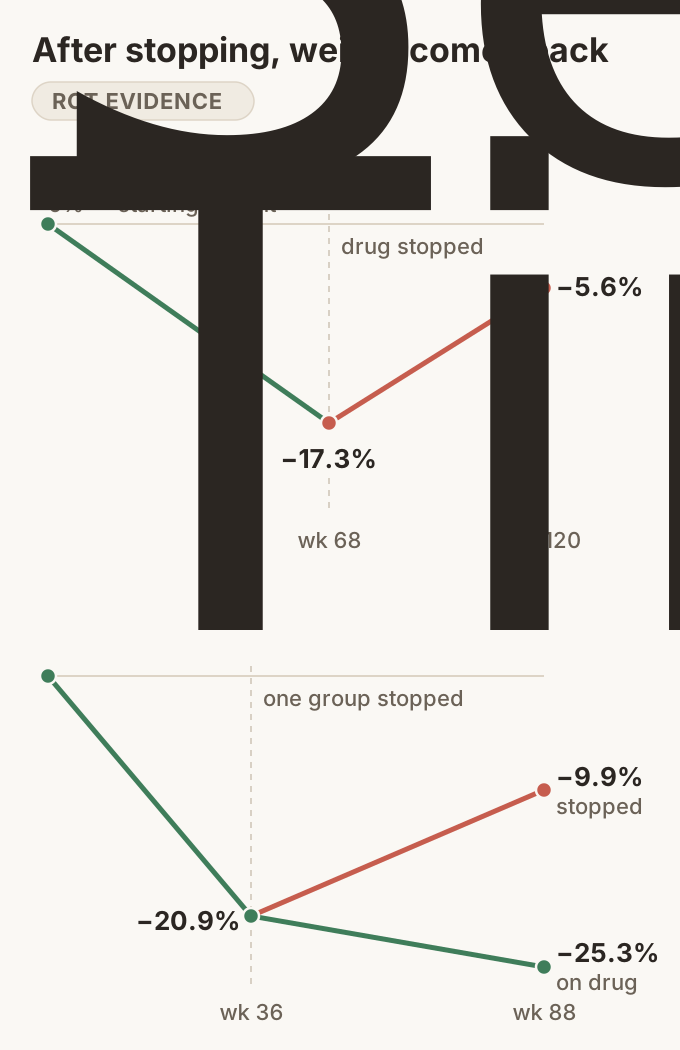
A third trial closes the loop. STEP 4 ran a randomized withdrawal in the other direction: after a 20-week semaglutide run-in, people switched to placebo regained 6.9% over the next 48 weeks while those who continued lost a further 7.9% — ending at −5.0% versus −17.4% from baseline. Three randomized trials, two molecules, one consistent answer. (The STEP 1 extension also found most cardiometabolic improvements — blood pressure fully among them — reverted toward baseline as weight returned, with some lipid and CRP benefits partially persisting; that’s supported but limited, since it’s downstream of the regain itself.)
If you take a GLP-1 for type 2 diabetes — or have diabetes alongside obesity — the clock is faster. Everything above moves on a scale of months. Blood sugar does not. Because these medicines also lower glucose, losing one can let blood sugar rise within days to weeks of the last dose — a documented consequence of stopping the drug, not a maybe. That makes a forced stop a call-your-prescriber-now situation, not a wait-and-see one: your medication plan usually needs adjusting, and checking your blood glucose during the gap matters. The specifics of what to change, and when, are an individualized decision that belongs to you and your prescriber.
What about the felt experience — the hunger, the return of food noise? Split the claim in two, because its halves sit on different rungs. The pharmacology is label-grade: semaglutide’s elimination half-life is about one week, and it remains in circulation roughly 5–7 weeks after the final dose, so nothing switches off overnight (see our half-life explainer). But the timing of returning appetite — the “food noise came roaring back in week two” posts — is observational and anecdotal: commonly reported within days to weeks, plausibly beginning before the drug has fully cleared, and never measured on a validated schedule. Any site handing you a precise appetite-return calendar is manufacturing precision the data doesn’t contain.
The regain curve is not a verdict on you. It’s the documented behavior of a chronic condition when treatment stops — which is exactly why the plan matters more than the panic.
That framing — regain as disease recurrence, not treatment failure — is the current expert position (a 2026 editorial commentary in Cureus synthesizing these trials; supported but limited, as framing built on established data). Obesity behaves as a chronic, relapsing condition: withdraw the drug and the homeostatic machinery it was quieting re-emerges, pushing weight toward its prior set point. The same commentary flags a physiological reason to take regain seriously rather than shrug at it: regain is often fat-preferential, raising a sarcopenic-obesity concern — you can return to the old weight with a worse body composition than you left it with. Recurrence framing is the honest middle between two lies: “you’ll lose it all back, the drug was a crutch” and “just keep the habits and you’ll be fine.” The realistic playbook lives on our keeping weight off and stopping a GLP-1 pages.
The panic is predicted by the biology
Read the forums after any coverage purge and the same thread repeats: my plan dropped it, the food noise is back, and I feel like I’m watching myself undo a year of work in real time. Those accounts are community reports, not measured incidence — no one has run a clinical study of the psychology of forced GLP-1 discontinuation — but they deserve to be taken at face value, because the biology predicts them. If appetite regulation genuinely shifts back within weeks of stopping, then panic, grief, and shame are reasonable responses to a real bodily change, not evidence of a weak character.
Shame assumes you failed at something. You didn’t stop the drug — a formulary decision, a supply chain, or a side effect did. Grief is the proportionate response; shame is a category error.
The “it was only the drug” spiral deserves one more push. The drug didn’t do the year of appointments, injections, side-effect management, and rebuilt habits — you did, with a medicine that made the biology cooperate. If the stigma voice is loud right now, the “easy way out” article takes it apart directly.
If the spiral goes darker than grief — hopelessness that won't lift, or thoughts of harming yourself — that is not something to wait out or attribute to a coverage letter. In the U.S. you can call or text 988 (the Suicide & Crisis Lifeline) any time, or contact your local emergency number.
What to actually do first
None of the moves below is “find another supply.” They’re ordered because each one can make the next unnecessary.
First, read the denial like a document, not an insult. The stated reason — non-formulary, prior authorization lapsed, indication not covered, plan exclusion — determines which lever exists. Our coverage checker walks the vocabulary.
Second, know that the exception and appeal machinery is a right, not a favor. For Medicare Part D, under current CMS rules (2026), a formulary-exception request with your prescriber’s supporting statement must be decided within 72 hours — 24 hours if expedited — and a denial can proceed to internal appeal and then independent external review. Commercial plans operate parallel processes. These are regulatory facts, and plans are counting on you not knowing them.
Third, have the bridging conversation with your prescriber — a specific one, not a vague “what now.” The landscape has three honest lanes:
| The lane | What it is | What it is not |
|---|---|---|
| Fight the denial | Exception request, then appeal, on the clocks above — with your prescriber’s statement doing the heavy lifting | A guaranteed win; success depends on the denial reason and plan rules |
| A covered alternative | The plan’s formulary may cover a different molecule or product for your indication — a category your prescriber can evaluate (how switching works) | Our recommendation to switch — that call belongs to you and your prescriber |
| A planned, clinician-guided pause | A deliberate stop with a maintenance plan, monitoring, and re-entry criteria — a legitimate option, not a failure | A taper protocol from the internet; there’s no evidence taper vs. abrupt stopping changes long-term regain (emerging / expert opinion) |
One thing to expect if the plan is to resume the drug after a gap: you probably won’t pick up where you left off. After a break, these medicines are typically not restarted at the prior maintenance level — prescribers usually re-titrate upward again from a lower starting point, because coming back at full strength tends to bring the GI side-effect cliff (nausea and the rest) back with it. That’s the standard principle, not a schedule; the exact restart plan is your prescriber’s call. Knowing it’s coming is what keeps a re-titration from feeling like a setback.
Walking in prepared changes what that appointment can do — the visit agenda builder and the off-ramp mapper exist for exactly this, and the maintenance navigator picks up whichever lane you land in.
What a coverage gap does not change: a gap is not a reason to stretch, split, or improvise doses, and it is not a reason to turn to gray-market or unverified compounded products — an unregulated supply is a new risk, not a bridge. Any change to how you take a prescribed medicine is a prescriber conversation. This site sells nothing and sources nothing; that's precisely why we can say this plainly.
The honest bottom line
Being forced off a GLP-1 is two events wearing one coat: a policy event you can sometimes fight, and a biological event you can plan for. The trials say most — not all — of the lost weight tends to return within a year without the drug, because the condition is chronic and the drug was treating it. That fact is neither a reason for despair nor a thing to be talked out of; it’s the reason the appeal clock, the formulary conversation, and the maintenance plan are worth more than any amount of 2 a.m. searching. You didn’t fail a medicine that a spreadsheet took away. Now make the spreadsheet do the paperwork.
Frequently asked
- Will I regain all the weight if I'm forced to stop a GLP-1?
- On trial averages, most of it but usually not all of it. In the STEP 1 extension, people regained about two-thirds of lost weight in the year after stopping semaglutide, ending a mean 5.6% below where they started — and 48.2% still held a clinically meaningful (≥5%) loss one year off the drug, down from 86.4% on it. Averages hide a wide spread; your curve is not guaranteed to match the mean in either direction.
- How fast does appetite or "food noise" come back after stopping?
- The pharmacology is established: semaglutide's elimination half-life is about one week, and it remains in circulation roughly 5–7 weeks after the last dose, so the drug fades gradually rather than switching off. The return of hunger and food preoccupation is commonly reported within days to weeks — but that timing comes from patient and clinician reports, not controlled trials, so no honest source can give you an exact schedule.
- Can I fight an insurance denial for my GLP-1?
- Yes — a formulary exception is a defined process, not a favor. Your prescriber submits a supporting statement; under current CMS rules (2026), Medicare Part D plans must answer a standard exception request within 72 hours and an expedited one within 24 hours, and a denial can move to internal appeal and then independent external review. Commercial plans run their own versions of the same machinery. Step one is always the denial letter itself: the stated reason determines which lever applies.
- Is regaining weight after stopping my fault?
- No. The current expert framing treats obesity as a chronic, relapsing condition: when the drug stops, the homeostatic biology it was holding back re-emerges and pushes weight toward its prior set point. Regain after discontinuation is disease recurrence — the expected behavior of the condition — not evidence that you lacked willpower or that the loss wasn't real.
- Should I stretch out my remaining doses to bridge a coverage gap?
- That's a regimen decision only your prescriber can make with you, and this site never gives dosing guidance. What the evidence does support spending your energy on: reading the denial reason, filing the exception or appeal, and having a specific bridging conversation — covered alternative, appeal, or a planned, clinician-guided pause with a maintenance plan.
Sources (7)
Every claim on this page traces to a primary source — and we sell you nothing. No sponsors, no affiliate links, no ads.
- 3 randomized trials
- 2 other primary
- 1 FDA labels
- 1 guidelines
More like this