Evidence journey
GLP-1s After 60: Weight Loss Holds Up — Muscle and Bone Are the Real Story
Almost everyone over 60 arrives with the same belief: the weight comes off slower because I'm older. The age-subgroup data don't support it — and point to a more useful conversation about muscle, bone, and what to track instead of the scale.
A 68-year-old sits across from her doctor with a printout of her weight over the last four months. It’s coming down — steadily, not dramatically — and she says the thing almost everyone her age says first: I figured it’d be slower for me. I’m older. It’s such a reasonable belief that nobody in the room questions it. Metabolism slows with age; surely the weight follows.
Here’s the odd part: the trial data don’t back her up. When researchers split the big GLP-1 studies by age, the people over 65 lost about as much weight as everyone else. The premise she walked in with — the one most 60-somethings walk in with — is the one part of the story the evidence actually contradicts. And correcting it opens up the conversation that matters far more at her age, which was never really about the scale.
The belief, tested
Take the “slower after 60” idea apart and it fails at the trial-average level in every place we could check.
A pooled analysis of the STEP semaglutide trials looked specifically at participants aged 65 and older. In a conference analysis presented at EASO 2026 (not yet peer-reviewed), they lost 15.4% of body weight versus 5.1% on placebo — essentially matching the broader trial population. A separate post hoc of the tirzepatide program (SURMOUNT and SUMMIT) in adults 65+ reported weight reduction “broadly comparable” to under-65s. And in STEP-HFpEF, a peer-reviewed heart-failure trial that enrolled genuinely old patients, weight loss did not fade with age: the 75-and-over group lost 11.5% on semaglutide versus 3.8% on placebo (a placebo-adjusted difference of 7.7%), with no statistical age interaction.
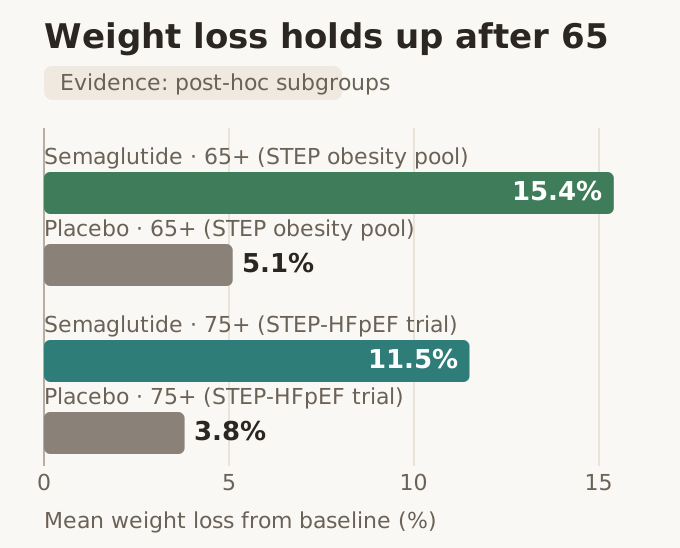
So the grade on “loss is slower after 60” is not supported at the trial-average level, with the direction consistent across three independent analyses. Individual pace still varies for all the usual reasons, which is a separate question from whether age itself slows you down. It doesn’t appear to.
Three independent subgroup analyses, one answer: at the trial-average level, being older didn’t mean losing less. The belief nearly everyone arrives with is the one the data pushes back on.
Where the evidence gets thin
The catch isn’t that older adults lose less. It’s that we know much less about the oldest of them.
In that STEP 65+ pool, only 358 of 4,523 participants were 65 or older — about 8% — and roughly 90% of those were between 65 and 74. Do the arithmetic and the 75-and-over evidence rests on a few dozen people. On top of that, obesity trials tend to enroll healthier-than-average older adults: few frail, few with advanced muscle loss, few with the stacked conditions that define real-world geriatric medicine.
Read the number honestly. "Comparable weight loss after 65" is well-supported for relatively fit 65-to-74-year-olds. It is weakly supported past 75, and barely studied at all in frail or already-sarcopenic adults — the exact people whose muscle and bone we worry about most. A thin evidence base isn't a red light; it's a reason to individualize, not to assume the trial average applies to everyone.
This is the part most “seniors on Ozempic” coverage gives a single line, or skips. It deserves its own paragraph, because the gap is precisely where the age-specific stakes live.
Comparable weight loss doesn't mean comparable tolerability. In a pooled safety analysis of semaglutide in adults 65 and older, gastrointestinal adverse events reached 73.8% versus 48.6% on placebo, serious adverse events ran 19.0% versus 12.7%, and discontinuation for side effects was higher than in the trials overall. Nausea, vomiting, and diarrhea are not just unpleasant after 60; in a body with less reserve they drive volume depletion, dizziness, and falls. That's why the decision to start and how closely to monitor belongs to a clinician who knows you, not a rate to wave away.
What the scale hides: muscle
For a 68-year-old, the interesting variable was never the weight — it’s what the weight is made of.
Any weight loss, by any method, sheds some lean mass alongside fat. On a GLP-1, the split is fairly consistent: in the SURMOUNT-1 DXA substudy, fat mass fell 33.9% and lean mass 10.9% — roughly a 75% fat / 25% lean split, similar in the placebo group and stable across age and sex. A network meta-analysis across GLP-1 drugs landed in the same place: lean mass was about 25% of total weight lost, and as a percentage of body composition, lean mass held steady. In other words, the trials do not show disproportionate muscle wasting on average.
That’s the reassuring half. The counterweight is specific to age.
| The claim | What the evidence says | Honest grade |
|---|---|---|
| “Muscle loss is proportional, not disproportionate” | ~25% of weight lost is lean mass, similar to diet or surgery; relative lean % unchanged (DXA substudy + network meta-analysis) | Supported but limited — but from mostly younger trial populations |
| “In older adults, muscle and strength may fall faster” | 24-month retrospective cohort (mean age ~72): greater loss of muscle index, grip strength, and gait speed with semaglutide, dose-dependent | Observational only — confounded, no diet/activity data, can’t prove cause |
| “The same proportional loss matters more at 70 than at 40” | Older adults start with less muscle and blunted muscle-building response (anabolic resistance) — established geriatric physiology | Supported but limited — background biology, not a proven GLP-1 harm |
The observational study is the grey middle no one writes: older semaglutide users lost more appendicular muscle and more grip strength than matched controls, in a dose-dependent pattern. But it’s retrospective, the groups differed in ways nobody measured, and the authors themselves say it can’t establish cause. Pair it with the plain fact that a 70-year-old has less muscle in reserve and rebuilds it less readily, and you get the real message: the proportion of muscle lost may be similar to a 40-year-old, but the consequence of losing it isn’t. That’s why the mechanics of protecting muscle — enough protein and resistance training — go from “good idea” to “the part of the plan you don’t skip.” We cover the muscle question in depth on the muscle-loss page; here the point is that age raises the stakes, not the percentage.
What the scale hides: bone
Bone is the shrug of this whole topic — not because it’s fine, but because we barely have data.
The one older-adult study to look directly found no significant whole-body bone-density difference between the GLP-1 and control groups (p=0.77), and no significant change in the bone-turnover markers CTX or P1NP. Reassuring? Only barely. It enrolled 20 people over 20 weeks, with limited weight loss and a non-significant hint in the wrong direction. A study that small and that short can’t detect a real effect and can’t rule one out.
Twenty people, twenty weeks. That’s not “GLP-1s are safe for bone” — it’s “we don’t yet have enough data to say,” which is a different and more accurate sentence.
Grade: preliminary. The takeaway for an older adult isn’t alarm; it’s that bone belongs on the list of things a clinician tracks, especially for anyone already carrying fracture risk.
The scorecard that actually matters after 60
This is where the whole question turns over. If weight loss behaves about the same with age, and the real risks are muscle and bone, then the scale is the wrong scoreboard entirely. The outcomes that predict whether an older adult stays independent are things the trials increasingly measure directly.
| Non-scale outcome | What a trial actually showed | Population |
|---|---|---|
| Knee pain | WOMAC pain fell 41.7 vs 27.5 on placebo; SF-36 physical function +12.0 vs +6.5 (STEP 9, P<0.001) | Obesity + moderate knee OA, mean age ~mid-50s |
| Heart-failure symptoms | KCCQ symptom score: +5.6-point placebo-adjusted (between-group) difference in the 75+ group (p-interaction 0.80) | HFpEF, 25.5% were 75+ |
| Walking distance | 6-minute walk: +16.3 m placebo-adjusted (between-group) difference in the 75+ group (p-interaction 0.96) | HFpEF, 75+ subgroup |
| Cardiovascular events | 20% fewer major cardiovascular events, consistent across age (SELECT) | Established CVD, mean age 61.6, no diabetes |
Two caveats keep this from being oversold. STEP 9’s knee-osteoarthritis win came from a general-obesity population in its mid-50s — powerful, but applied to a 70-year-old by extension, not by direct proof. And the STEP-HFpEF benefits belong to a specific heart-failure group. What’s striking is that in the trial built with genuinely old patients, the symptom and mobility gains held across the full age spectrum, including past 75 — the same place the weight-loss evidence thinned out, the functional evidence stayed strong.
For the wider menu of what “working” can look like beyond a falling number, we wrote a whole piece on non-scale victories. For an older adult, that’s not a consolation prize. It’s the main event: grip that holds a railing, a gait fast enough to cross a street, knees that let you keep gardening, a heart that keeps you out of the hospital.
The Medicare reality
None of the above matters if the drug is out of reach, and for older Americans the coverage picture has its own hard edges — worth stating cleanly, because most consumer pages muddle it.
Medicare and GLP-1s, as of July 2026:
- Not covered for weight loss. A statutory Part D exclusion has barred coverage of drugs "used for weight loss" since Part D began in 2006. That's law, not a formulary quirk.
- Covered by medical indication. The same molecules are covered for type 2 diabetes, for cardiovascular risk reduction (Wegovy, after the SELECT trial), and for obstructive sleep apnea (Zepbound). Coverage follows the diagnosis, not the brand name.
- A temporary bridge. A GLP-1 Bridge demonstration runs July 1, 2026 through December 31, 2027, offering limited weight-loss access at a $50/month copay. It's a time-limited pilot — the broader BALANCE model's Part D component was indefinitely delayed in April 2026 for insufficient plan participation.
That’s the policy landscape, not a workaround. Formularies and demonstrations change, so treat every detail here as dated to mid-2026 and confirm your own plan before deciding anything. The deeper mechanics live on our cost and access page.
What to actually do with all this
The point of correcting the “slower after 60” myth isn’t to sell anyone on these drugs. It’s to move the conversation to the questions that carry real weight at this age — and hand those questions to the right person.
If you’re weighing a GLP-1 in your 60s or 70s, these are worth bringing to a clinician (and, for the muscle and mobility parts, a physical therapist):
- How will we protect and track my muscle? Ask about a baseline and follow-up — grip strength, gait speed, or a sit-to-stand test — not just the scale.
- What’s my fall and fracture risk, and should bone be monitored? Especially if you already have osteoporosis or a history of fractures.
- Given my frailty level, does the benefit outweigh the muscle risk for me? There’s no trial that answers this for the frailest adults; it’s a judgment call that belongs to someone who knows your whole picture.
- What are we actually treating — my weight, my knees, my heart, my diabetes? The answer shapes both the goal and, for Medicare, whether it’s covered at all.
- What non-scale changes should tell us this is working? Agree on them up front so a plateau on the scale doesn’t get misread as failure.
What you won’t find here, on purpose, is a dose, a titration schedule, a supplier, or a workout prescription. Muscle risk is dose-related in the observational data, which is exactly why the dose decision belongs to a prescriber weighing your frailty — not to a website. If you want to walk in with your own numbers instead of a single bad-morning reading, the trajectory-check tool lays your curve against the typical range.
After 60, the scale is the least interesting thing a GLP-1 does. Whether you keep your strength, your mobility, and your independence is the whole story — and it’s the story worth tracking.
The honest bottom line
The belief that weight comes off slower after 60 didn’t survive contact with the age-subgroup data — older adults in the trials lost about as much as everyone else, right up to the edge where the evidence runs out at 75-plus. The trade-off that actually deserves attention is quieter and more consequential: you lose muscle on any weight-loss path, and at 70 you have less to spare and less capacity to rebuild it. Weighed against that are wins the trials do measure and that matter enormously at this age — less knee pain, more walking distance, fewer cardiovascular events, more years of staying independent. Hold both, track the right things, and have the muscle-and-bone conversation out loud with someone who knows you. That’s the version of this that’s actually about your life, not your bathroom scale.
Frequently asked
- Do you lose weight more slowly on a GLP-1 after 60?
- Not at the trial-average level. In a conference analysis of pooled STEP trials presented at EASO 2026 (not yet peer-reviewed), adults 65 and older lost 15.4% of body weight on semaglutide versus 5.1% on placebo — essentially the same as the broader population. In the peer-reviewed STEP-HFpEF heart-failure trial, weight loss did not fade even past 75. Individual pace varies for many reasons, but "it's slower because I'm older" isn't supported by the age-subgroup data.
- Will a GLP-1 make me lose muscle at my age?
- Some lean mass comes off with any weight loss. In the trials, roughly 25% of total weight lost was lean mass — similar to dieting or surgery, so not disproportionate on average. The catch specific to older adults: you start with less muscle in reserve, and a 24-month observational study found faster muscle and grip-strength decline in older semaglutide users. That's an association from retrospective data, not proof, but it's why muscle deserves a plan and a clinician conversation.
- Does Medicare cover Ozempic or Wegovy for weight loss?
- No — a statutory Part D exclusion has blocked coverage of drugs "used for weight loss" since 2006. But Medicare does cover these molecules for approved medical indications: type 2 diabetes, cardiovascular risk reduction (Wegovy, after the SELECT trial), and obstructive sleep apnea (Zepbound). A temporary GLP-1 Bridge demonstration adds limited weight-loss access from July 1, 2026 through December 31, 2027.
- What should I track instead of the scale after 60?
- The outcomes that predict independence: grip strength, walking speed, how easily you get off the floor, knee and joint pain, and staying out of the hospital. These are the measures trials increasingly use, and for an older adult they matter more than a single morning's weight. Our non-scale victories guide walks through how to track them.
- Is a GLP-1 safe for someone in their 70s or who is frail?
- There's no dedicated trial to answer that. The frailest, highest-sarcopenia-risk adults are exactly the group the obesity trials under-enrolled, so the honest answer is that frailty-versus-benefit is a judgment call for a clinician who knows you — weighing muscle and fall risk against the cardiovascular, joint, and mobility gains. It's a conversation to have, not a verdict to read off a website.
Sources (12)
Every claim on this page traces to a primary source — and we sell you nothing. No sponsors, no affiliate links, no ads.
- 6 randomized trials
- 2 meta-analyses
- 1 news / agency
- 1 observational studies
- 1 other primary
- 1 reviews
More like this