Myths & headlines
'Did you even try?' The science that dismantles the 'easy way out'
'You didn't earn it.' The insult assumes weight is held in place by willpower. Decades of physiology say the body actively defends a higher weight — slowing metabolism for years and keeping hunger hormones switched on. That biology is exactly what these drugs treat.

It usually arrives as a comment, or a look. Did you even try? That’s the easy way out. You didn’t earn it. Sometimes it comes from a stranger online, sometimes from a relative across the dinner table, sometimes from the person’s own head at 2 a.m. The words vary; the accusation is the same. A medicine helped, therefore the weight loss doesn’t count — because real weight loss is supposed to hurt.
The insult is confident. It is also built on a specific, testable claim about how the human body works. And that claim is wrong.
The premise the insult depends on
Strip away the tone and “easy way out” makes one assumption: that body weight is held in place mainly by willpower, so anything that helps must be a shortcut around effort. If that were true, the moral math would follow — effort is virtuous, a shortcut is cheating.
But that is not how weight is defended. Two well-documented biological systems make sure of it, and neither has anything to do with character. The first slows the engine. The second turns up the hunger.
The ‘easy way out’ argument isn’t cruel because it’s mean. It’s wrong because it misdescribes the machine — it treats a defended biological system as a test of willpower.
Your body fights the weight it lost
Lose a meaningful amount of weight and your resting metabolism — the calories you burn just staying alive — falls by more than your smaller body should require. Physiologists call this metabolic adaptation or adaptive thermogenesis. It is not a fringe idea: after roughly a 10% weight loss, resting energy expenditure typically runs about 50 to 140 kcal/day below what body-composition change alone predicts, and it stays suppressed while the lower weight is maintained (established — consistent human data; Müller 2016 review).
The most vivid measurement of it came from following contestants of the TV show The Biggest Loser. Six years after the competition, their resting metabolism was still running about 499 kcal/day below what their body size predicted — and, strikingly, the suppression appeared to deepen over time even as most of the weight came back (established; Fothergill 2016, n=14). This was a small, unusual group under extreme conditions, so the exact numbers don’t transfer to everyone. But the direction is not in doubt: the body defends a higher weight, and it does not give up quickly.
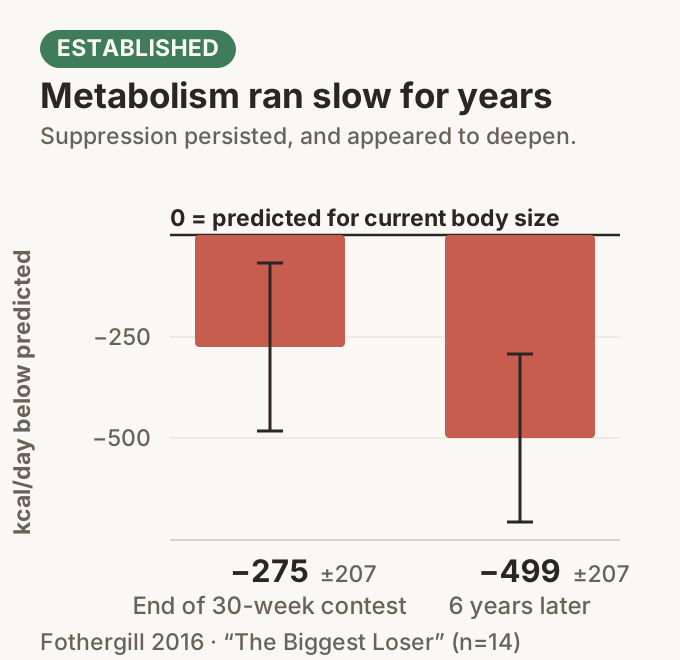
Roughly 500 fewer calories a day, and still present six years later, is a headwind no amount of grit erases. It is the metabolic equivalent of running up an escalator that has started moving down.
The hunger hormones don’t reset either
If a slower engine were the whole story, you could out-discipline it. But the second system removes even that option: after weight loss, the hormones that govern appetite shift toward eating — and they stay shifted.
In a careful study, 50 adults lost about 13.5 kg on a supervised low-energy diet. A full year later, their appetite hormones had not returned to baseline: leptin, which signals fullness, was still down; ghrelin, which drives hunger, was still up; and their rated appetite was still elevated (established; Sumithran 2011). A year of feeling hungrier than you did before, driven by chemistry you can’t feel or vote on — that is the environment in which “just eat less” is supposed to work.
This is why loss-then-regain is the pattern, not the exception. The body doesn’t experience your diet as success. It experiences it as a famine to be corrected.
Put the two systems together and the willpower model collapses. Fewer calories burned, more hunger felt, for at least a year and sometimes for years. Regain isn’t a referendum on your discipline. It’s the expected output of a system doing exactly what it evolved to do.
“So it is a shortcut” — no
Here’s where honesty has to cut both ways. If the point were simply that the drug is heroic, we’d be trading one myth for another. It isn’t. GLP-1 medicines (semaglutide — the drug in Wegovy/Ozempic) don’t bypass this biology — they act on it, quieting appetite and the intrusive, persistent thoughts about food that many people call “food noise” (emerging; Hayashi 2023 — a conceptual model built on patient-reported (anecdotal) accounts and food-cue-reactivity theory). That makes the defended set-point easier to fight. It does not make the fight disappear.
The trial evidence says so plainly. In STEP 1 — the pivotal semaglutide trial — participants lost about 14.9% of body weight versus 2.4% on placebo over 68 weeks (established; Wilding 2021). But the drug was never tested alone: both groups received counseling on a reduced-calorie diet and increased physical activity. The medicine was the addition, not the replacement.
And the clearest rebuttal to “shortcut” is what happens when people stop. In the trial’s withdrawal extension, participants regained roughly two-thirds of the lost weight within a year of stopping the medication (established; Wilding 2022). A cheat code doesn’t work like that. A treatment for a chronic, biologically-defended condition does.
| The claim | What the evidence shows | Honest grade |
|---|---|---|
| “Weight is held in place by willpower” | Metabolism slows and hunger hormones stay shifted for months to years after loss | Not supported — the biology defends a higher weight |
| “GLP-1s make weight loss effortless / no diet needed” | Both STEP 1 arms dieted and moved more; stopping the drug returns ~2/3 of the weight | False — the effort doesn’t vanish |
| “GLP-1s are a tool that acts on the biology of weight defense” | They quiet appetite and food noise, improving the odds against a tilted system | Established (mechanism) / emerging (food noise) |
This is the frame that survives contact with the evidence: a tool, not a cheat code, and not effortless. Overclaiming “effortless” would be as wrong as the stigma it rebuts.
It’s a disease, not a character flaw
None of this is a fringe reinterpretation. The medical mainstream got here years ago. The American Medical Association formally recognized obesity as a disease in 2013, and the World Obesity Federation describes it as a “chronic relapsing progressive disease process” (established professional consensus; AMA Resolution 420, 2013; World Obesity Federation position statement, 2017). “Relapsing” is the operative word — it names, in clinical language, exactly the regain that the “easy way out” crowd reads as personal failure.
“Relapsing” is a clinical word for the exact thing the insult reads as failure. Managing a relapsing disease with a medicine you continue isn’t cheating — it’s how chronic conditions are treated across the whole of medicine.
The insult has a cost of its own
There’s a final reason to retire the “easy way out” line: it does measurable harm, and lecturing people out of it doesn’t work.
In a 2026 experiment with 402 U.S. women aged 30–49 — a reproductive-age group for whom, worth noting, GLP-1 medicines are not recommended in pregnancy and are a specific clinician-conversation point — viewing GLP-1 weight loss as an “easy way out” predicted more stigma — more blame, more dislike, more desire for social distance (emerging; single experimental study, Post et al. 2026). And weight stigma isn’t a harmless attitude: in healthcare settings it is associated with care avoidance, poorer communication, and worse outcomes (observational; Phelan 2015, Puhl 2023 — association, not proof of cause).
The uncomfortable twist is that facts alone don’t fix it. In two 2025 experiments, the public rated obesity as substantially “willpower-controllable” (about 5.5 on a 9-point scale), and simply informing people that anti-obesity medications work did not reduce that willpower-blame (emerging; two experiments). Telling someone “the drug is real medicine” bounces off. Showing them the escalator running down — the slowed metabolism, the stuck hunger hormones — is a different conversation.
Worth holding both: the biology is established — metabolic adaptation and the persistence of hunger hormones are well-documented human findings. The stigma research (that "easy way out" beliefs drive blame, and that information alone doesn't dissolve it) is emerging — real, but from a small number of experiments. We grade them differently on purpose.
The honest bottom line
Not a cheat code. Not effortless. A tool that acts on a biology built to defend a higher weight. That’s the whole of it, and none of it is a shortcut.
The “easy way out” accusation fails on its own terms. It assumes a body that keeps weight off by willpower, and that body doesn’t exist — real ones slow their metabolism and raise their hunger to claw weight back, for years. GLP-1 medicines are not a way around that work; they are a way to act on the biology that makes the work so lopsided, and the moment they stop, the biology reasserts itself. Not a cheat code. Not effortless. A treatment for a condition medicine has recognized as a disease for over a decade — which is a far more interesting truth than the insult it replaces.
None of this means the medicines are right or risk-free for everyone — they are prescription drugs with real side effects and contraindications, and whether to start or continue one is an individual medical decision. Whether any specific medicine is right for a specific person is a conversation for that person and a qualified clinician, not something a headline or a dinner-table comment can settle. If you want to pressure-test a claim you saw about these drugs, check a claim you saw; to go deeper on the appetite side of the story, see our explainer on food noise.
Frequently asked
- Is taking semaglutide (Wegovy) 'cheating' or the easy way out?
- No — the framing rests on a false premise. It assumes weight is held in place mainly by willpower, so a drug must be a shortcut around effort. Physiology says the body actively defends a higher weight through slowed metabolism and shifted hunger hormones. GLP-1 medicines act on that biology; they don't bypass it, and they are not effortless — in the trials the drug was added to diet and activity changes, and stopping it brings much of the weight back.
- If it's not a shortcut, why do people regain weight after stopping the drug?
- Because the drug is managing an ongoing biological process, not curing it — much like blood-pressure medicine. In the STEP 1 trial extension, participants regained roughly two-thirds of the lost weight in the year after stopping semaglutide. That regain is evidence the medicine was doing real work against a body that defends its former weight, not that willpower had lapsed.
- Doesn't the medication just do all the work for you?
- No. In the pivotal trial, both the drug group and the placebo group received counseling on a reduced-calorie diet and increased physical activity. The medicine changes the odds against a biologically tilted game — it quiets appetite and 'food noise' so the effort has a chance to pay off — but it does not remove the need to eat and move differently.
- Why can't I just lose the weight with willpower?
- Many people can lose weight; the hard part is keeping it off, and that's where biology pushes back. After weight loss, resting metabolism is suppressed and hunger hormones stay shifted toward eating — for at least a year in one careful study, and for years in another. This is why loss-then-regain is the common pattern, and it reflects physiology, not character.
Sources (13)
Every claim on this page traces to a primary source — and we sell you nothing. No sponsors, no affiliate links, no ads.
- 4 reviews
- 3 other primary
- 2 observational studies
- 2 guidelines
- 2 randomized trials
More like this