Evidence journey
Protecting muscle on a GLP-1 when you can't just "go lift"
Every muscle-preservation guide says "eat protein and lift weights" — and quietly assumes a gym and a body that cooperates. If your knees don't, here's what the evidence actually supports, and where it honestly runs out.
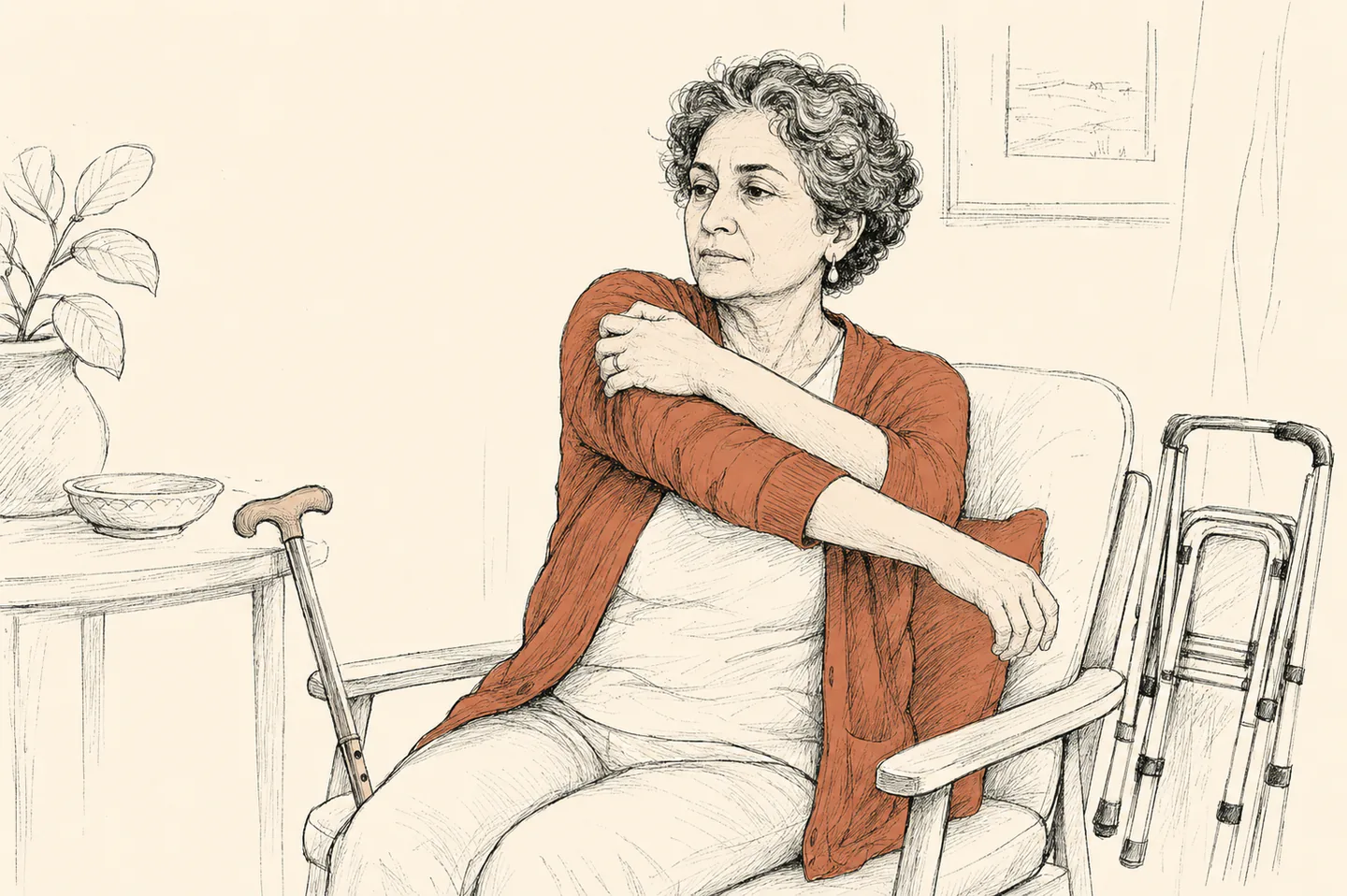
The advice is always the same, and it always assumes the same body. Eat your protein and lift weights. It shows up under every article about muscle loss on Ozempic, Wegovy, Zepbound — confident, universal, and quietly built for someone who can walk into a gym and load a barbell. If your knees are shot, if standing for ten minutes is its own project, if “just lift” is a sentence that makes you want to close the tab, that advice doesn’t feel like help. It feels like a door with your name crossed off.
So let’s do the harder, more honest thing: separate what the evidence actually shows from what the fitness internet assumes. The short version is that you are not disqualified from protecting your muscle. You are under-studied — which is a very different problem, and a much more workable one.
First, the thing nobody should soften: you will lose some muscle
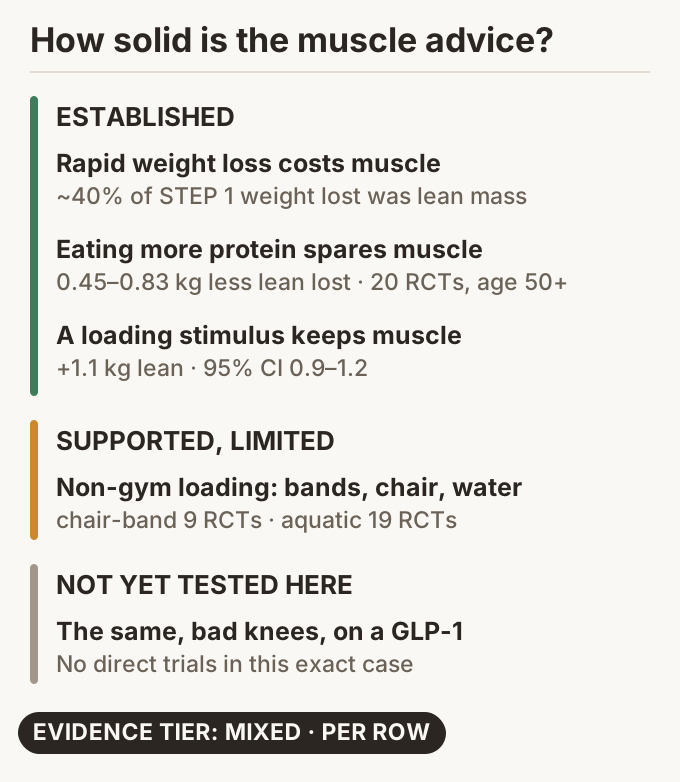
Rapid weight loss costs muscle. Not just fat — muscle. This is true however the weight comes off, and it’s true on GLP-1 and GLP-1/GIP medicines. The best-verified anchor is the DEXA body-composition substudy of STEP 1, the pivotal semaglutide trial. Over 68 weeks, people on semaglutide lost about 15% of their body weight versus 3.6% on placebo — and when the scanner broke that down, roughly 40% of the weight lost was lean (non-fat) mass. This is Established — human trial data, measured by scan, not inferred.
That number deserves respect. It does not deserve panic, and the same substudy tells you why.
Why this isn’t the catastrophe the headlines want
Here’s the part the scary version leaves out. In that same STEP 1 substudy, the loss was preferentially fat. Fat mass fell about 19% (visceral fat nearly 27%), while lean mass fell about 10%. Because fat left faster than muscle, lean tissue’s share of the body actually rose by about 3 percentage points, and the lean-to-fat ratio improved — most in the people who lost the most weight. This is Supported-but-limited: one exploratory substudy of 140 people, not the whole story, but a real and measured one. (Published body-composition analyses of tirzepatide trials show the same preferential-fat pattern; the exact figures weren’t verifiable at review, so treat them as corroboration of the direction, not new numbers.)
You are not melting your muscles to lose fat. You’re losing more fat than muscle, and ending up with a body that is a higher percentage muscle than when you started. That’s the opposite of the wasting story.
Whether the muscle you do lose ever becomes a clinical problem — real weakness, sarcopenia — is genuinely debated, not settled. In general populations it looks reassuring. In higher-risk groups — older adults, people with conditions that already predispose to muscle loss — it’s a legitimate concern worth watching. Holding both of those at once is the honest position — and it’s exactly the one most articles refuse to hold.
The two levers that actually have evidence
Strip away the noise and there are only two interventions with real data behind them for keeping muscle during weight loss. Neither one requires a specific machine or a specific body.
Protein. In a meta-analysis of 20 randomized trials in adults aged 50 and older, people eating a higher-protein diet during weight loss lost roughly 0.45–0.83 kg less lean mass — and more fat — than those eating normal protein. Put differently: at least 30% of the weight lost came from lean tissue in about 22% of the higher-protein comparisons, versus about 48% of the normal-protein comparisons. The effect is modest and real. Grade: Established / supported-but-limited.
A loading stimulus. Making muscle work against resistance is a well-established way to build and hold onto it. Pooled across trials in aging adults, resistance-type training added about +1.1 kg of lean mass (95% CI 0.9–1.2). That gain was measured in aging adults generally — a lean-mass gain studied outside a weight-loss context, and not tested head-to-head against diet or aerobic exercise. So its value for keeping muscle specifically while calories are down is a reasonable inference, not a proven result. Grade: Supported — the weight-loss-specific benefit is directional.
| Lever | What the evidence shows | Honest grade |
|---|---|---|
| Higher protein during weight loss | ~0.45–0.83 kg less lean mass lost; 20 RCTs, adults 50+ | Established / supported-but-limited — modest, real |
| Resistance / loading stimulus | ≈ +1.1 kg lean mass (95% CI 0.9–1.2); measured in aging adults generally, outside a weight-loss context | Supported — resistance training builds/retains lean mass in adults; weight-loss-specific benefit is directional inference |
| Either one, in a limited-mobility body during a GLP-1 | No direct trials — inference across two literatures | Speculative — no direct trial yet, not disproven |
Notice what the middle row does not say. It doesn’t hand you a gram target or a rep count, because both of those depend on your kidneys, your joints, your appetite, and your baseline — the individual facts a website can’t see.
“Resistance training” is a principle, not a barbell
This is where the standard advice quietly cheats. It says “resistance training” and shows you a barbell, as if the tool is the treatment. It isn’t. The active ingredient is the stimulus — muscle repeatedly working against a load. The barbell is just one delivery route, and it’s the one route your knees may have ruled out. Others exist, and several have been tested in precisely the population the fitness internet ignores.
- Chair-based, resistance-band work. A meta-analysis of 9 randomized trials (878 participants) in long-term-care residents — many of them wheelchair or walking-aid users — found that seated resistance-band programs significantly improved handgrip strength and upper- and lower-limb muscle endurance. Seated. Bands. Real strength gains.
- Water. A meta-analysis of 19 randomized trials (866 participants) found aquatic exercise improved lower-limb strength, flexibility, and mobility in older adults — with the water carrying the load your knees can’t.
- Physio-guided and machine-supported loading, matched to whatever your body will tolerate, deliver the same stimulus through a route a professional has cleared for you.
Before you start any of these, get cleared. Before beginning any new movement — even gentle band, chair, or water work — get it cleared by your clinician, especially if you have heart, lung, or kidney conditions, and start under a physical therapist's supervision rather than on your own. Getting in and out of a pool, and being immersed in water, changes how your heart and circulation work — exactly the kind of thing a professional should green-light before you try it.
The evidence never actually asked for a barbell. It asked for load. Bands, a chair, a pool, a resistance machine set light — these are different envelopes for the same letter.
All of these land at Supported-but-limited: the trials are real and randomized, but they were run in older or mobility-limited people generally — not during GLP-1 weight loss. Which brings us to the boundary the honest version has to name out loud.
Where the evidence honestly runs out
Here is the sentence most articles will never write: nobody has tested whether protein plus non-gym loading preserves muscle specifically in a limited-mobility body during rapid GLP-1 weight loss. That exact study doesn’t exist. What we have are two solid but separate literatures — the GLP-1 body-composition data (measured mostly in general, able-bodied trial populations) and the protein-and-loading data (measured mostly in able-bodied or generally-mobile older adults) — that have to be bridged to reach your situation. Bridging is reasonable. It is not the same as proof.
So the transfer to your case is Speculative — an inference, graded as one. That’s not a brush-off. It’s the difference between “the science guarantees this will work for you” (false) and “the mechanisms and adjacent trials point this way, and the gap is that no one has run the study” (true). The data hasn’t excluded your case; it simply hasn’t reached it yet.
Why "keep it now" beats "rebuild it later." Aging muscle resists rebuilding — in the resistance meta-analysis, older adults gained less lean mass per unit of training than younger ones. That's the argument for protecting muscle while you lose weight rather than betting you can add it back afterward. The regain is not guaranteed to be easy, so the loss is worth minimizing up front.
What to actually do — which is have a conversation
Because the specifics are individual and the boundary is real, the useful deliverable here is not a workout and not a protein number. It’s a short list of questions to bring to a clinician or, ideally, a physical therapist — the person who can see your knees and your kidney panel and build the plan a website can’t.
Bring these to a clinician or physical therapist:
- Given my knees, pain, and mobility, which loading options are safe for me — seated, bands, aquatic, machine-supported, PT-supervised?
- Can I get a physical-therapy referral, and can we set function goals — standing from a chair, stairs, carrying groceries — instead of gym goals?
- How should I think about protein for my body, my kidney status, and my appetite while I'm eating less on this medication?
- If I take insulin, a sulfonylurea, or other diabetes medicines, how should I adjust food, fluids, or timing before adding exercise — since new activity plus eating and drinking less can push blood sugar too low or leave me dehydrated?
- What should we track over time — grip strength, a sit-to-stand test, body composition — and how often?
- Are there red flags — new weakness, falls, rapid deconditioning — that should change my plan or the pace of weight loss? And is my current rate of loss reasonable for protecting muscle?
That last question — the pace of weight loss — belongs to your prescriber, not to you and a dose chart. If muscle loss becomes a concern, adjusting the medication is a clinical decision, framed as a question you raise, never a change you make on your own.
If you want to go deeper on the pieces, we’ve graded each one on its own: how much muscle you actually lose, what the protein evidence really supports, and exercise on a GLP-1. And if you’d rather walk into that appointment with your own version of the list above, the muscle-protection question builder turns it into something you can hand across the desk.
The bottom line
Rapid weight loss costs muscle — that part is settled, and softening it would be dishonest. But the catastrophe framing is wrong: on the best trial data, fat loss dominates and muscle’s share of your body goes up. The two levers that protect it — protein and a loading stimulus — don’t require the body the fitness internet assumes. Loading is a principle, and it has more than one delivery route, several with their own trials in people who use wheelchairs and walking aids. What no one has done yet is test the exact combination in your exact situation. That makes you under-studied, not disqualified — and the smartest move you can make is to bring the gap, and the questions, to someone who can see the whole of you.
Frequently asked
- Will I lose muscle on a GLP-1 if I physically can't exercise?
- Some, yes — rapid weight loss costs muscle whether or not you exercise. In the STEP 1 body-composition substudy about 40% of the weight lost was lean mass. But fat loss dominated and lean mass as a share of the body rose. You can't make the loss zero, but protein and a loading stimulus — in whatever form your body allows — are the two levers the evidence supports for keeping more of it.
- Do I have to lift weights, or is there another way?
- The evidence backs a loading stimulus, not a specific tool. What preserves muscle is repeatedly making it work against resistance. Resistance bands, seated or chair-based movements, water, and machine- or physio-supported work are all delivery routes — and chair-band and aquatic programs have their own trials in older, mobility-limited adults. A physical therapist can match a route to your knees.
- How much protein should I eat to protect muscle on a GLP-1?
- That number is a clinician's call, not a website's. Trials in older adults that spared muscle used higher-protein diets, but the right target for you depends on your kidney health, your appetite while eating less, and your body — which is exactly why it belongs in a conversation with your prescriber or a dietitian, not in a one-size number here.
- Does the muscle just come back after I stop losing weight?
- Don't count on easy regain, especially if you're older. Aging muscle is harder to rebuild — older adults gained less lean mass per unit of training in the resistance meta-analysis. That's the argument for protecting muscle during weight loss rather than assuming you can add it back later.
- Is losing muscle on a GLP-1 dangerous?
- It's debated, not settled. Whether GLP-1-related lean-mass loss translates into meaningful weakness or sarcopenia looks reassuring in general populations but is a real concern in higher-risk groups — older adults and people with conditions that already predispose to muscle loss. That's a reason to monitor function with a clinician, not a reason to avoid treatment.
Sources (7)
Every claim on this page traces to a primary source — and we sell you nothing. No sponsors, no affiliate links, no ads.
- 5 meta-analyses
- 1 randomized trials
- 1 reviews
More like this