Living with it
Dropped by your insurer mid-GLP-1: the 2026 coverage cliff
In 2025–2026, pharmacy benefit managers, employers, and Medicare rules quietly cut GLP-1 coverage for weight loss. If your refill got denied, you didn't do anything wrong — the decision happened at the policy layer, and the appeal system is a defined legal right with deadlines.

The pharmacy called it a “plan change.” Same drug, same prescriber, same body that had lost weight steadily for a year — and suddenly a refill that used to cost a copay now rang up at full price, or wasn’t covered at all. If that has happened to you in the last year, the first thing worth saying is the thing your denial letter won’t: you didn’t do anything wrong, and neither did the medicine.
Coverage for weight-loss GLP-1s is being cut at the policy layer — by pharmacy benefit managers (PBMs), employers, and public-program rules — not because of anything about you or how well the drug worked. That distinction matters, because it points your energy at the right lever. You can’t out-comply a formulary decision. But you can read it, decode it, and — in many cases — appeal it.
Whether a GLP-1 is covered tracks the indication and the plan, not the patient. The lever that moved was never you.
The map: mostly not covered, and it’s getting narrower
Start with the landscape, because the panic of a single denial makes more sense once you see how little of the map is covered ground.
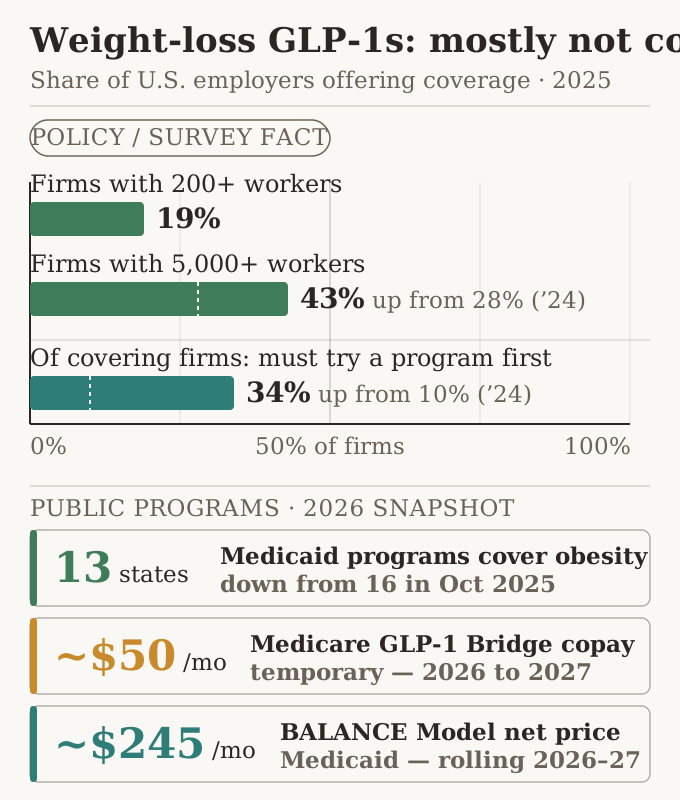
Those employer bars set the baseline, so read them carefully. In KFF’s 2025 employer survey, only 19% of firms with 200 or more workers covered GLP-1s when they were used primarily for weight loss. Even at the largest employers — 5,000 workers and up — it was 43%, up from 28% the year before (established policy/survey fact). So a slim minority of large employers offer the obesity benefit at all, and among the ones that do, 34% required workers to join a lifestyle or case-management program first in 2025, up from 10% in 2024 (established survey fact). The trend line for access is rising slightly; the trend line for strings attached is rising faster.
Why it got cut: three forces, none of them you
The pullback isn’t one decision. It’s three, converging in 2025–2026.
| The force | What it does | Why it flipped your coverage |
|---|---|---|
| PBM formulary wars | The middlemen who manage drug benefits pick “preferred” drugs based on manufacturer rebates | A single rebate deal can remove your drug from the covered list overnight — the CVS/Zepbound whiplash below |
| Employer benefit design | Most employers still don’t buy the obesity benefit; those that do gate it | If your plan never covered weight-loss use, or your employer changed plans, access ends at renewal — not at your next visit |
| Public-program statute | Medicare is barred by law from covering weight-loss use; Medicaid varies by state | Coverage depends on your diagnosis and your state, not on the drug itself |
The through-line is the “same molecule, different indication” principle: a GLP-1 prescribed for type 2 diabetes is a far better-covered animal than the same molecule prescribed for obesity (established policy fact). Coverage follows the indication on the claim. That’s why two people on chemically identical prescriptions can have wildly different bills — and why a change in diagnosis code, plan, or formulary can move you from “covered” to “denied” without a single thing changing about your health.
The whiplash: CVS, Zepbound, and why it can flip twice
The clearest illustration of the policy layer in motion is Zepbound — a drug that went off the covered list and back onto it in under eighteen months.
On July 1, 2025, CVS Caremark — one of the largest PBMs — removed Zepbound (tirzepatide) from its main commercial “template” formulary, steering members toward Wegovy (semaglutide) after a manufacturer rebate deal (established policy fact). Patients who had done nothing but follow their prescription found their drug off the list. The move was driven by price negotiation, not by any finding that one drug worked better than the other; it became the subject of class-action litigation, and those allegations remain unproven in court (reported / news; litigation ongoing).
Then it reversed. On May 28, 2026, CVS announced that Zepbound would return as an additional preferred option on October 1, 2026 for plans that elect it, and separately unblocked Foundayo (orforglipron), Eli Lilly’s oral GLP-1, effective June 1, 2026 (established policy fact). Foundayo itself is new: the FDA approved it for obesity on April 1, 2026, and it carries a boxed warning about thyroid C-cell tumors (established regulatory fact).
Your access to a specific drug can flip twice in eighteen months for reasons that have nothing to do with your health. That is not a bug in how you’re using the system — it is the system.
The practical lesson isn’t “switch to whatever’s preferred.” It’s that a formulary is a moving target, and “Zepbound is dropped, period” was only ever true on a specific date, for specific plans. The honest move is to check your own plan’s current formulary rather than trust a headline — including this one.
The public-program overlay: Medicare’s statutory wall
If you’re on Medicare or Medicaid, a different rule dominates, and it’s older than the current GLP-1 boom.
Medicare is statutorily prohibited from covering drugs “used for weight loss” — a bar written into the Medicare Modernization Act of 2003, which references the Medicaid excludable-drug list (established statutory fact). So a GLP-1 is Part D–coverable only for an eligible diagnosis: type 2 diabetes, or — since Wegovy’s cardiovascular approval in 2024 — cardiovascular risk reduction (established regulatory fact). The Biden administration proposed reinterpreting the exclusion to cover anti-obesity use starting in 2026; the current administration declined to finalize it on April 4, 2025, so the statutory exclusion stands (established regulatory fact).
A temporary demonstration now carves a narrow window outside the normal benefit — and its limits matter as much as its existence.
The temporary program is narrow and gated — read the fine print. The Medicare GLP-1 Bridge runs July 1, 2026 through December 31, 2027, with a roughly $50/month copay — but that copay does not count toward your Part D deductible or out-of-pocket cap, and low-income subsidies don't apply because it operates outside Part D. Eligibility requires a BMI ≥35, or ≥27 with additional clinical criteria, plus Part D enrollment and prescriber attestation. A second, separate demonstration — the BALANCE Model — was not launched in Medicare for 2027 (CMS extended the Bridge instead) and is instead rolling out in Medicaid across 2026–2027, where manufacturers agreed to a roughly $245 net price per 30-day supply. So for someone on Medicare, the Bridge is the live program, not BALANCE — and none of this means "Medicare now covers Ozempic for weight loss." (Program facts as of mid-2026; these demonstrations have shifted more than once, so confirm against the current CMS page.)
On the Medicaid side, coverage is shrinking, not growing: 13 states covered GLP-1s for obesity as of January 2026, down from 16 in October 2025 (established policy fact). The cost pressure behind the pullback is real — gross Medicaid GLP-1 spending rose from roughly $1 billion in 2019 to about $9 billion in 2024 (established spending fact, pre-rebate). None of that is a judgment about whether the drugs work. It’s a budget colliding with a statute.
What to actually do: read the letter, then have the right conversation
Here’s the part the vendor pages skip, because it doesn’t sell anything. When coverage stops, the productive first move is to read the denial reason — and different reasons open different doors. This is general literacy about how the system works, not advice about your specific regimen; which path fits you is a conversation for your prescriber and plan.
| What the letter says | What it means | The category of response it opens |
|---|---|---|
| Formulary removal | Your drug left the covered list (the CVS/Zepbound situation) | Formulary exception / appeal, or a covered alternative |
| Utilization management | Prior authorization, step therapy (“try Wegovy first”), or a quantity limit | Appeal — often the strongest case, especially with a documented reason an alternative won’t work |
| Indication / eligibility rule | Covered for diabetes or CV risk but not obesity; BMI threshold not met | Confirm the diagnosis on the claim; discuss eligibility with your prescriber |
| Hard plan exclusion | Your employer bought a plan that excludes anti-obesity drugs entirely | The toughest case — appeals rarely override a bought exclusion |
The most important thing to know is that the appeal isn’t a favor you’re begging for. It’s a defined legal process.
The appeal is a legal right with a clock. A patient or prescriber can request a formulary or tiering exception, backed by a prescriber's supporting statement. For Part D, the plan must decide a standard request within 72 hours and an expedited request within 24 hours; a denial opens further internal appeal and then independent external review. (Established regulatory-process fact.) The framework is procedural — the medical case for any one person belongs to that person and their clinician.
Once you know the reason type and the deadlines, the choices sort into three plain categories — and a person and their clinician pick among them; a web page can’t:
- Appeal / request a formulary exception — most relevant for utilization-management denials and formulary removals, and strongest when there’s a documented reason a covered alternative is unsuitable.
- Move to a covered alternative already on your plan’s list — this is what a PBM steers you toward, but whether a different molecule is right for you is a clinical decision, not a formulary’s decision and not this page’s. One thing worth knowing: these drugs aren’t interchangeable at the same dose, so switching products generally means restarting the step-up process under a prescriber, not swapping one for another milligram-for-milligram.
- Pause and reassess with a clinician — a legitimate, guided option, not a failure, when neither appeal nor switch is workable. How and whether to stop, and what happens to appetite and weight afterward, is exactly the kind of thing to plan with a prescriber. And if your GLP-1 is also treating type 2 diabetes or was prescribed for cardiovascular risk reduction, an unplanned pause isn’t just about weight — it can affect blood sugar or cardiovascular protection, so it’s especially not a stop-on-your-own decision.
What this page won’t do — on purpose
The category around this topic is crowded with pages that turn a coverage denial into a sales funnel: cash-pay workarounds, telehealth vendors, compounded “alternatives,” coupon aggregators. We’re not going to do that, and the reason is the whole point.
A formulary loss is a coverage problem, and the compounded and grey-market supply chain is a separate risk topic — not a coverage workaround. “My plan stopped paying” and “where can I get it cheaper without a covered prescription” are different questions with very different safety profiles, and collapsing them is how people end up worse off. If cost is the barrier, the honest levers are the appeal system, the indication conversation with your prescriber, the public-program rules if they apply, and the patient-assistance and pricing options a licensed pharmacist can walk you through — not a stranger’s link.
The pages that monetize this anxiety have to tell you your specific drug was your only option. It usually wasn’t — and finding that out costs nothing but a careful read of your own denial letter.
The honest bottom line
A denied refill feels personal. The decision behind it almost never is — and knowing that is the difference between blaming yourself and working the actual levers.
The coverage cliff is real, it’s still moving, and in 2026 it is mostly a story about policy — rebate deals, employer benefit design, and a two-decade-old statute — not about patients. That’s not comforting in the moment a refill gets denied, but it’s clarifying: it tells you the lever that moved was never you, and it points you at the ones you can actually pull. Read the letter. Learn which reason you’re facing. Know that the appeal is a right with a deadline, that the same molecule is covered differently for different diagnoses, and that the public-program exceptions are narrow and dated. Then have the specific conversation — with your prescriber and your plan — that a web page can’t have for you.
For the pricing and access mechanics in more depth, see our evidence page on GLP-1 cost and access. And because formularies change month to month, treat every figure here as dated: confirm your own plan’s current coverage before you make a decision.
Frequently asked
- My GLP-1 was covered last year and now it's denied — did I do something wrong?
- Almost certainly not. Coverage for weight-loss GLP-1s is being cut at the policy layer — by pharmacy benefit managers, employers, and public-program rules — for reasons that have nothing to do with you or how well the drug worked. The most useful first step is to read the denial notice and identify the reason type (formulary removal, prior authorization, indication rule, or a hard plan exclusion), because that determines what options even apply.
- Does Medicare cover Ozempic or Wegovy for weight loss?
- Not for weight loss itself. By statute, Medicare cannot cover a drug used for weight loss. A GLP-1 is Part D–coverable only for an eligible diagnosis — type 2 diabetes, or (since 2024) cardiovascular risk reduction with Wegovy. A temporary demonstration, the Medicare GLP-1 Bridge (July 2026–December 2027, about $50/month), creates a narrow, gated exception outside normal Part D. A second model, BALANCE, was postponed in Medicare for 2027 and is instead rolling out in Medicaid — so it doesn't help most Medicare beneficiaries.
- Can I appeal a coverage denial, and how fast is it?
- Yes — it's a defined legal process. A patient or prescriber can request a formulary or tiering exception with a prescriber's supporting statement. Part D plans must decide standard requests within 72 hours and expedited requests within 24 hours; a denial opens further internal appeal and independent external review. Whether an appeal or a covered alternative fits your situation is a conversation for your prescriber and plan.
- Why did CVS Caremark drop Zepbound?
- A rebate deal, not a safety or effectiveness finding. CVS Caremark removed Zepbound from its main commercial template formulary on July 1, 2025, steering members to Wegovy after a manufacturer price negotiation. After backlash and litigation, CVS announced on May 28, 2026 that Zepbound would return as an additional preferred option on October 1, 2026 for plans that elect it.
- Is a GLP-1 covered differently for diabetes than for weight loss?
- Yes, and it's the single biggest lever. The same molecule prescribed for type 2 diabetes is far better covered than when it's prescribed for obesity. Coverage follows the indication on the claim, so eligibility rules, prior authorization, and BMI thresholds hinge on the diagnosis attached to the prescription.
Sources (12)
Every claim on this page traces to a primary source — and we sell you nothing. No sponsors, no affiliate links, no ads.
- 5 news / agency
- 5 other primary
- 2 guidelines
More like this