Evidence journey
The Scale Barely Moved — But Is It Still Working? Response Beyond the Number
Your weight has barely budged this month, but your last labs looked better than they have in years. So which one is telling the truth about whether the drug is working? Often both — and the scale is the least of them.
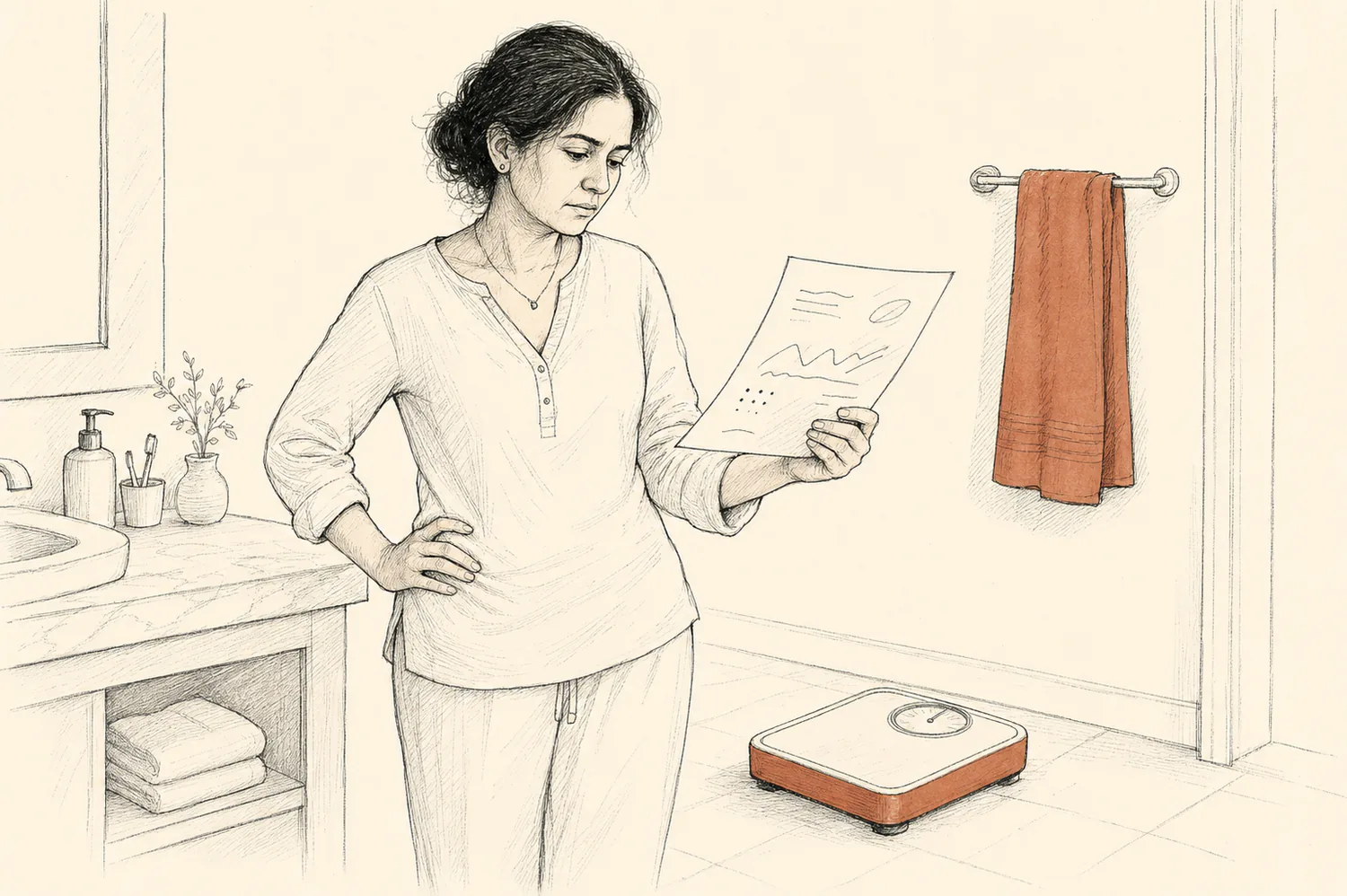
You weigh yourself Monday morning, same as always. The number is the same as last Monday, and roughly the same as the Monday before that. Then you open the message from your clinic: A1C down, blood pressure down, the first genuinely good labs in years. So which one is telling you the truth about whether this is working — the scale that won’t move, or the panel that just improved?
Almost nobody says this out loud to a frustrated dieter: the scale is the least informative reading you have. It’s the one you check daily precisely because it’s cheap and quick, not because it’s the best measure of what the drug is doing to your body. The pivotal trials that got these medicines approved measured weight — and they also measured glucose, blood pressure, waist size, visceral fat, lipids, and hard outcomes like heart attacks, strokes, kidney decline, and sleep apnea. “Working” was never defined as pounds alone. So before you conclude a stalled scale means a failed drug, it’s worth seeing the whole dashboard.
The scale is one row of a much bigger table
Think of a GLP-1’s effect as a spreadsheet, not a single cell. Weight is the top row, and it’s the one that grabs your attention — but it sits above a stack of other measured readouts, several of which can move while the scale holds still. This isn’t a motivational reframe; it’s what the trials actually recorded.
| Readout | What the trials measured | Where it shows up |
|---|---|---|
| Body weight | The headline number — real, but only one row | The scale |
| Glucose / A1C | Regression to normal blood sugar 69.5% vs 35.8% (SELECT, non-diabetic cohort); progression to diabetes cut 73% | Blood test |
| Systolic blood pressure | −6.16 vs −1.06 mmHg (STEP 1) | Cuff |
| Waist & visceral fat | Waist −13.54 cm (STEP 1); visceral fat −40.1% (SURMOUNT-1) | Tape measure, imaging |
| Lipids & CRP | Improved with semaglutide vs placebo (STEP 1) | Blood test |
| Heart attacks & strokes | ~20% fewer major events (SELECT) | Years of outcomes |
| Kidney decline | 24% lower risk of the kidney composite (FLOW) | Blood/urine over time |
| Sleep apnea (AHI) | −25.3 events/hour vs −5.3 (SURMOUNT-OSA) | Sleep study |
Populations differ — a benefit shown in one trial doesn’t automatically transfer to a different situation. SELECT = semaglutide in adults with established cardiovascular disease and no diabetes (the glucose-normalization row is from this non-diabetic cohort); STEP 1 = semaglutide in obesity; SURMOUNT-1 = tirzepatide in obesity; FLOW = semaglutide in type 2 diabetes with chronic kidney disease; SURMOUNT-OSA = tirzepatide in obesity with obstructive sleep apnea.
Every one of those is an established finding — each backed by a landmark randomized trial, several of them now FDA-approved indications as of 2026 (cardiovascular risk, chronic kidney disease in type 2 diabetes, and obstructive sleep apnea among them). The point isn’t to memorize the numbers. It’s that a person whose weight stalled but whose A1C and blood pressure improved isn’t imagining a win — they’re reading a different, arguably more important, row of the same table. We keep the organ-by-organ evidence ladder on a separate page for the beyond-weight-loss benefits; here the job is simpler: to stop treating the top row as the whole spreadsheet.
Most of the benefit runs off the scale
Now the fact that reframes the entire question — and that almost no plateau article tells you.
When researchers went back into SELECT (17,604 people with obesity and established heart disease, but no diabetes) and asked a prespecified question — how much of the cardiovascular benefit was actually explained by weight loss? — the answer was: not most of it. Only about 33% of the reduction in heart attacks and strokes was statistically mediated by the change in waist size — that is, could be traced back to the weight people lost. Roughly two-thirds was independent of how much weight anyone lost. There was no clean linear trend tying early weight loss to fewer events, and the benefit held up across every baseline weight and waist category.
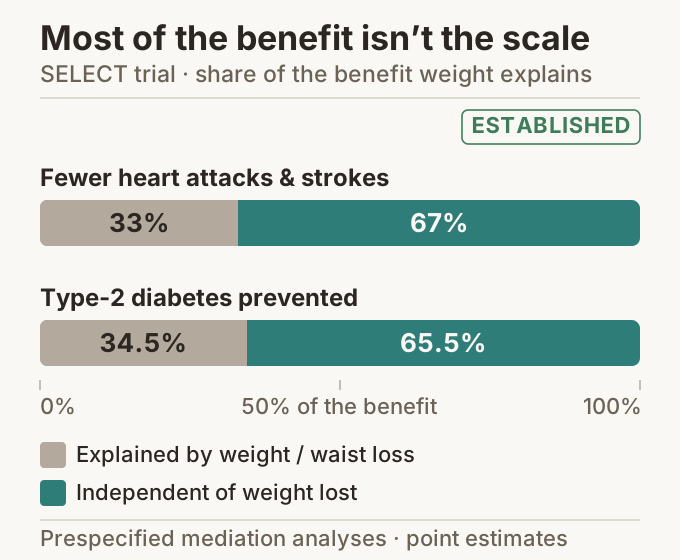
The diabetes side tells the same story even more directly, which matters if your worry is “my scale stalled but my sugar improved.” In that same population, semaglutide cut progression to type 2 diabetes by 73% (hazard ratio 0.27), and pushed nearly 70% of people back to normal blood sugar versus about 36% on placebo — while mean weight loss was only about 9.7%. Of that diabetes-prevention effect, only 34.5% could be traced to the weight lost. About two-thirds was weight-independent. Glucose benefit, in other words, largely does not wait for the scale.
A drug can barely touch your weight and still be measurably protecting your heart and your blood sugar. In the biggest trial we have, roughly two-thirds of both benefits ran off the scale entirely.
Three honest guardrails. First, “not proportional to pounds lost” is not “weight is irrelevant” — this is about the mechanism split, not a license to ignore body weight. Second, these are population-level, prespecified analyses: strong evidence about how the drug works on average, not a personal promise, and your labs are measured and interpreted by your clinician, not by a chart. Third, a disclosure worth naming: the pivotal trials behind this piece — SELECT, STEP 1, SURMOUNT-1, FLOW, STEP-HFpEF, and SURMOUNT-OSA — were funded by the manufacturers (Novo Nordisk or Eli Lilly), which is standard for the trials that earn a drug its approval; tellingly, the mediation result and the benefit in people without diabetes cut against a simple marketing story rather than for it.
The scale hides what your body is actually doing
Even the weight row itself is misleading, because a scale can’t tell fat from muscle from water. When trials looked inside the weight change with DXA body scans, the composition of the loss wasn’t what the number suggests — the fat compartment falls faster than the total implies.
| Body-composition readout | SURMOUNT-1 (tirzepatide) | STEP 1 (semaglutide) |
|---|---|---|
| Total body weight | −21.3% | (weight-loss trial) |
| Fat mass | −33.9% | −19.3% |
| Lean mass | −10.9% | not reported here |
| Share of loss (fat / lean) | ~74% / ~26% | ~60% / ~40% |
| Visceral (organ) fat | −40.1% | −27.4% |
| Waist circumference | −18.1 cm | −13.54 cm |
Visceral fat — the metabolically dangerous fat packed around your organs — drops far faster than total weight. So a scale that’s moved a little can sit on top of a waist that’s moved a lot and a visceral-fat compartment that’s moved even more. That’s why a belt loosening while the number sticks is a genuinely good sign, not a consolation prize.
But this cuts both ways, and false comfort helps no one. Notice that a real fraction of the loss — roughly a quarter to 40% in these substudies — is lean mass. That is not the drug building muscle, and it’s not benign “recomposition.” Rapid weight loss of any kind, including from diet alone, sheds lean tissue in a similar ratio. The accurate, narrow claim is this: fat falls faster than total weight, so the scale understates the fat you’ve lost — not that muscle is safe. Protecting muscle is a real, open concern, and we handle it honestly on the muscle-loss page. These figures are supported but limited — exploratory DXA substudies, not powered outcomes.
“Slow loss” is really four different things
Here’s the trap the internet falls into: it collapses every stalled scale into one diagnosis, usually “plateau — eat less or switch.” But a scale that isn’t moving fast can mean at least four completely different things, and they carry different meanings.
| What it looks like | What’s actually happening | What the evidence says |
|---|---|---|
| Under 5% early, discouraged | Too early / slow-starter | In SURMOUNT-1, 18% were under 5% at week 12 — but ~90% of those slow starters caught up to ≥5% by week 72, and only ~1.8% of everyone stayed under 5%. Being slow early rarely means finished. |
| Real loss, then it flattens | A genuine plateau | A distinct, expected phase — the body defends a lower weight. See our plateau page. |
| Number stuck, belt looser | Scale-masked fat loss | Fat and visceral fat still falling; the scale is understating it (see above). |
| Flat weight and flat labs | True low / non-response | Uncommon: only ~1.8% of SURMOUNT-1 participants stayed under 5% at 72 weeks. |
Response to these drugs is a wide spread, not a single number — across the STEP program, roughly 10 to 17% of people are low-responders under 5%, while a third or more are super-responders above 20%. The reason the distinction matters: three of those four states are not failure at all, and the fourth is genuinely rare. Before anyone concludes the drug isn’t working, the first three have to be ruled out — and timing alone rules out a lot of them. If you’re early, our piece on how long a GLP-1 takes to work walks through the two clocks that matter. The non-responder distribution has its own page too.
When it really might not be working
None of this is a promise that every stalled scale is secretly a triumph. That would be its own dishonesty — telling someone whose weight, labs, blood pressure, waist, and symptoms are all flat that it’s working anyway. Genuine non-response is real, and it’s the honest floor under this whole piece.
What genuine non-response looks like: little change on the scale and little change on the other readouts — A1C or glucose, blood pressure, waist size, lipids, how you feel and function — after an adequate dose taken for an adequate stretch of time, with too-early, plateau, and missed doses already ruled out. That combination is a real signal to reassess. It is a conversation with your prescriber, not a self-verdict, and never a reason to change your own dose or switch drugs on your own.
Which option follows — adjusting something, adding something, or reassessing the whole plan — is a clinician’s menu built around your goals and history. It is not something a website should hand you, and it is not something to reverse-engineer from a stalled number.
Retire the scale as the sole judge — but don’t replace it with false comfort. The honest version names every readout, celebrates the measured wins, and keeps a real floor for when nothing is moving at all.
What this means if it’s you
The practical version is calmer than the science. If your weight has stalled, the useful question isn’t “is the scale moving?” It’s “what is moving?” Pull the readouts you actually have — recent labs, blood pressure, how your clothes fit, your energy, your sleep — and look at the row that changed, not just the one that didn’t. A better A1C on a flat scale is not nothing; in the largest trial we have, that kind of benefit largely doesn’t depend on the scale at all.
The scale answers “how much do I weigh?” It was never built to answer “is this medicine protecting me?” Those are different questions, and only the second one is the point.
One more thing the scale can’t weigh: off-scale benefit is only one side of the ledger. How well you tolerate the drug matters just as much to whether it’s worth continuing — and new, severe, or persistent symptoms are a reason to contact your clinician promptly, no matter how good the labs look.
Then bring the full picture to the person who prescribed it. Not “the scale won’t move, up my dose” — that’s a decision neither you nor this page can make. Instead: “here’s my weight trend, here’s what my labs and blood pressure did, here’s how I feel and function — is this working the way we hoped?” That’s a question a clinician can actually answer, and it’s a far better one than the scale was ever equipped to settle. If you want a structured way to see whether a flat stretch is a real plateau or just noise, the trajectory-check tool and our list of non-scale victories are built for exactly this moment.
The scale barely moved. That’s one row. Before you decide the drug failed, read the rest of the table — because the biggest benefits these medicines have ever been shown to deliver were mostly never sitting on it.
Frequently asked
- My weight stalled but my A1C dropped — is the drug still working?
- Very often, yes. GLP-1s lower blood glucose through direct mechanisms that don't require a large weight change. In SELECT, semaglutide cut progression to type 2 diabetes by 73%, and only about a third of that effect was statistically explained by weight lost — so glycemic benefit is substantially weight-independent. A better A1C on a flat scale is a measured result, not a fluke. Your clinician interprets your labs, but improving numbers are the opposite of nothing happening.
- How much of a GLP-1's benefit actually comes from losing weight?
- Less than most people assume. A prespecified analysis of SELECT found only about 33% of the reduction in heart attacks and strokes could be traced back to (in trial language, was mediated by) waist-size change, and only about 34.5% of the diabetes-prevention effect traced to weight. Roughly two-thirds of each benefit was independent of the pounds lost. "Not proportional to weight" is not the same as "weight doesn't matter" — it means the drug does more than shrink you.
- If the scale isn't moving, am I wasting money — should I just stop?
- That's not a decision to make from the scale alone, and not one to make on your own. Before concluding a drug isn't working, the honest checklist is whether it's too early, whether you've hit a plateau after real loss, whether fat and waist are still falling while weight holds, and what your A1C, blood pressure, and other labs are doing. If all of those are genuinely flat after adequate time, that's a prescriber conversation — bring the full picture, not just the number.
- What counts as a true non-responder?
- In research terms, it's someone with little change on weight and the other readouts after an adequate dose and adequate time — and it's uncommon. In SURMOUNT-1, 18% of people were under 5% weight loss at week 12, but about 90% of those slow starters caught up to at least 5% by week 72 — and only about 1.8% of everyone on the drug stayed under 5%. Being slow early is common; being a true non-responder is rare, and only a clinician can make that call.
- The scale won't budge — should I ask to switch drugs or go up a dose?
- Whether a dose or a drug should change is a clinical judgment, not something this page or you should decide from a stalled scale. Self-adjusting a dose is off-label misuse. The right move is to gather your non-scale readouts — labs, blood pressure, waist, how you feel and function — and bring that to your prescriber, who can weigh it against your goals and history.
Sources (11)
Every claim on this page traces to a primary source — and we sell you nothing. No sponsors, no affiliate links, no ads.
- 10 randomized trials
- 1 reviews
More like this