Myths & headlines
GLP-1s beyond weight loss: what's proven, what's hype
In 18 months the same drug class was FDA-approved to cut heart attacks, protect kidneys, treat sleep apnea, and calm a diseased liver — and, in the same stretch, flunked its biggest test in Alzheimer's. Neither 'miracle drug' nor 'just weight loss' survives the evidence. Here's each use, graded on its own rung.

Look at what one drug class did in 18 months. Between March 2024 and August 2025, semaglutide and its cousin tirzepatide were approved by the FDA to cut heart attacks, to slow failing kidneys, to treat obstructive sleep apnea, and to treat a scarring liver disease. Four organ systems. Four separate landmark trials. And in the middle of that run, in November 2025, the same molecule was handed its most public defeat: a large, careful trial in Alzheimer’s disease that flatly did not work.
That collision is the whole story. One camp online has decided GLP-1s are a miracle that fixes everything. Another rolls its eyes: it’s just weight loss. Neither survives contact with the evidence. The honest picture is a ladder — each new use standing on its own rung, from “FDA-approved, giant trial” all the way down to “hypothesis that just lost in phase 3.” Here is the map.
The real “beyond weight loss”: four approvals, four trials
Start with the part that is solidly established, because it is remarkable and it is true. In a year and a half, four organ-level indications went from trial data to FDA approval — each backed by a randomized controlled trial, the strongest kind of evidence there is.
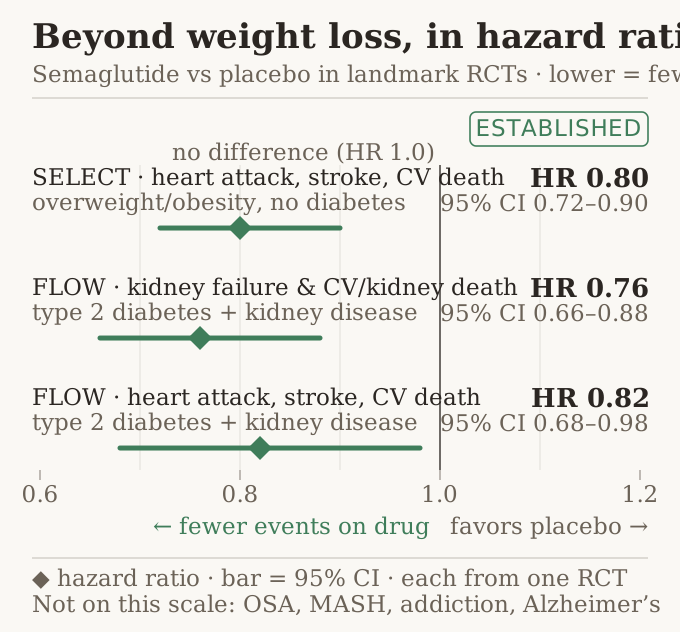
The heart. SELECT enrolled 17,604 adults who had obesity and established cardiovascular disease but not diabetes. Over about three and a half years, once-weekly semaglutide cut major cardiovascular events — cardiovascular death, heart attack, or stroke — from 8.0% on placebo to 6.5%, a hazard ratio of 0.80 (95% CI 0.72–0.90 — the confidence interval being the range the true effect most plausibly falls within). That is roughly a 20% relative reduction, and it earned Wegovy an FDA cardiovascular-risk-reduction indication on March 8, 2024 — the first weight-management drug ever shown to prevent cardiovascular events. Grade: established.
The kidneys. FLOW tested semaglutide in people with type 2 diabetes and chronic kidney disease, and was stopped early for efficacy. The primary composite — major kidney events plus kidney or cardiovascular death — fell by 24% (HR 0.76, 95% CI 0.66–0.88), an absolute reduction of about 4.9 percentage points over three years. The FDA approved that kidney indication for Ozempic on January 28, 2025. Grade: established — with one boundary that matters: the tested and approved population is type 2 diabetes with kidney disease, not kidney disease in general.
Sleep apnea. Two SURMOUNT-OSA trials gave tirzepatide to adults with moderate-to-severe obstructive sleep apnea and obesity — Trial 1 in people not using CPAP (off-PAP), Trial 2 in people already on it (the drug added on top). The apnea-hypopnea index — the number of times per hour breathing stalls — dropped by roughly 25 to 29 events on the drug versus about 5 on placebo. On December 20, 2024, Zepbound became the first medication the FDA has ever approved for obstructive sleep apnea. Grade: established — studied specifically in OSA with obesity. One safety line matters as much as the grade: do not stop or reduce CPAP on your own. Untreated moderate-to-severe OSA carries real cardiovascular and drowsy-driving risk, and whether the apnea-hypopnea index improves enough to change CPAP is a decision made with a sleep clinician after a repeat sleep study — not a self-directed one.
The liver. ESSENCE, a phase 3 trial in people with biopsy-confirmed MASH (metabolic dysfunction-associated steatohepatitis) and moderate-to-advanced fibrosis, reported MASH resolution in 62.9% on semaglutide versus 34.3% on placebo, and fibrosis improvement in 36.8% versus 22.4%. In August 2025 the FDA granted Wegovy accelerated approval for noncirrhotic MASH — the first GLP-1 for the condition. One honesty flag belongs in bold here: accelerated approval means the drug cleared a surrogate endpoint you can see on a biopsy, not yet the hard outcomes that matter most — progression to cirrhosis, liver failure, death. Those confirmatory data are still owed. Grade: established, with a surrogate-endpoint asterisk. (We go deeper on this in GLP-1s and fatty liver.)
Four organ systems, four randomized trials, four approvals — inside eighteen months. That pace is real, and it is the reason “it’s just weight loss” no longer describes this drug class.
One rung down: heart failure (HFpEF) — strong trial, no separate approval
Not every good trial becomes its own indication. Heart failure with preserved ejection fraction — HFpEF, the stiff-heart kind — is the clearest example. In STEP-HFpEF, 529 patients with HFpEF and obesity took semaglutide for a year. Their symptom and quality-of-life score (the KCCQ-CSS) improved by 16.6 points versus 8.7 on placebo — a placebo-adjusted gain of 7.8 points (95% CI 4.8–10.9) — and they walked farther in six minutes.
That is a real, well-run trial with a meaningful benefit. But it measured symptoms and function, not a hard outcome like death or hospitalization, and there is no separate FDA “HFpEF indication” — the benefit rides under the obesity and cardiovascular labeling. So the honest grade is supported but limited, not established. Same drug, different rung — which is exactly the point.
Alzheimer’s: the reversal the evergreen articles haven’t caught up to
Here is where the miracle narrative breaks. For years, “GLP-1s might treat dementia” was a staple of hopeful coverage, built on two things: laboratory rationale, and observational studies showing that people already taking these drugs seemed to get diagnosed with dementia a little less often. Observational studies can show an association. They cannot prove cause — the people who take a drug differ from those who don’t in a hundred ways you can’t fully adjust for.
So the question went to a controlled trial. Actually two: evoke and evoke+, together enrolling 3,808 people with early, amyloid-confirmed Alzheimer’s, on oral semaglutide, with cognitive decline (CDR-SB) as the primary endpoint. On November 24, 2025, the result landed: no significant slowing of Alzheimer’s progression. Some biomarkers moved; the clinical benefit did not appear.
This is the textbook case. An observational association ("GLP-1 users seem to get less dementia") plus a plausible mechanism is a reason to run a trial — not a reason to believe the drug works. When the trial was run, it was negative. Any evergreen page still calling GLP-1s "promising for Alzheimer's" is citing evidence that has since been overtaken. Association is not causation, and this is what that looks like in real time.
Parkinson’s disease has traveled a similar, if murkier, road. A small phase 2 trial of lixisenatide (LIXIPARK, 2024) hinted that treated patients held steadier on motor scores while placebo drifted worse — a marginal positive. The larger phase 3 trial, Exenatide-PD3 (194 people, 96 weeks, published 2025), was negative — no evidence of slowed progression. But that result now carries an asterisk of its own: on May 18, 2026, The Lancet issued an Expression of Concern over critical and major trial-conduct and data-integrity concerns at the trial’s King’s College Hospital site, with an investigation ongoing. With one marginally positive phase 2 and one negative phase 3 whose conduct is under formal question, the honest grade is emerging but disputed and unresolved — and, like Alzheimer’s, not an approved or proven use.
Genuinely promising, genuinely early: addiction
The most interesting open frontier is the reward system. GLP-1 receptors sit not just in the gut but in the brain’s reward circuitry — the same wiring that quiets “food noise” may, in principle, quiet other cravings. The early human data are encouraging. In a phase 2 trial, 48 adults with alcohol use disorder took low-dose semaglutide for nine weeks and showed a greater drop in heavy-drinking days over time, less craving, and fewer drinks per drinking day — each change statistically significant. The number of drinking days itself didn’t budge significantly.
Read that carefully: 48 people, nine weeks, low doses, and the authors themselves stress those limits. It is a real signal from a randomized trial — and nowhere near an approved use. Grade: emerging. Larger trials are underway and beginning to report, and we track this in GLP-1s and alcohol.
One thing this early signal does not mean: waiting on a GLP-1. Effective, FDA-approved medications for alcohol use disorder already exist — naltrexone and acamprosate — alongside behavioral therapy and mutual-help programs. An unproven GLP-1 signal is no reason to delay treatment that works today. If you or someone you know needs help, the SAMHSA National Helpline is 1-800-662-HELP (4357), and if you are in crisis, call or text 988, the Suicide & Crisis Lifeline.
| The use | Landmark trial | Honest grade |
|---|---|---|
| Cardiovascular risk (Wegovy) | SELECT — MACE HR 0.80 (0.72–0.90); FDA-approved Mar 2024 | Established |
| Chronic kidney disease in T2D (Ozempic) | FLOW — composite HR 0.76 (0.66–0.88); FDA-approved Jan 2025 | Established (T2D + CKD only) |
| Obstructive sleep apnea (Zepbound) | SURMOUNT-OSA — AHI −25 to −29/hr; FDA-approved Dec 2024 | Established (OSA with obesity) |
| Liver disease / MASH (Wegovy) | ESSENCE — MASH resolution 62.9% vs 34.3%; accelerated approval Aug 2025 | Established, surrogate endpoint |
| Heart failure (HFpEF) | STEP-HFpEF — KCCQ +7.8 vs placebo; no separate indication | Supported but limited |
| Alcohol use / addiction | Phase 2, n=48 — craving and heavy drinking down | Emerging (not approved) |
| Parkinson’s disease | Exenatide-PD3 phase 3 (n=194) — negative; trial conduct under Lancet Expression of Concern (2026) | Emerging / disputed, unresolved |
| Alzheimer’s disease | evoke / evoke+ (n=3,808) — no benefit, Nov 2025 | Not supported — failed phase 3 |
| Longevity / lifespan | No human longevity trial exists | Speculative |
Said out loud, the ladder runs like this. Established: the heart, the kidneys, sleep apnea, and — with a surrogate-endpoint asterisk — the liver. Supported but limited: HFpEF heart failure. Emerging: addiction. Disputed and unresolved: Parkinson’s. Failed phase 3: Alzheimer’s. Speculative: longevity. That single table is the thing neither the hype nor the dismissal will show you: the same drug class sitting on several different rungs at once. If you want the general tool behind it, see The Evidence Ladder.
The bottom rung: “live longer”
“GLP-1s are longevity drugs” is everywhere, and it is speculative — the plainest label on the ladder. No trial has ever tested a GLP-1 as an anti-aging agent. The one real thread people pull on is SELECT’s lower all-cause mortality (HR 0.81) — but that came from preventing heart attacks and strokes in people who were already at high cardiovascular risk. Preventing cardiovascular death in sick patients is not the same as slowing aging in healthy ones. The mechanism story is suggestive; the human evidence for “makes people live longer” does not exist yet.
The honest caveat that ties it together
There is one structural point that keeps this whole story truthful: “beyond weight loss” does not mean “unrelated to weight loss.” Most of these organ benefits travel alongside the weight and cardiometabolic changes the drugs produce. A few effects look partly weight-independent — SELECT’s event curves began separating within months, before much weight was lost, and FLOW’s kidney benefit points the same way — which is genuinely intriguing to researchers. But the trials do not establish some mystical direct-organ magic, and it would be dishonest to sell one.
These grades don't transfer between drugs or diseases. SELECT, FLOW, ESSENCE, and STEP-HFpEF are semaglutide; SURMOUNT-OSA is tirzepatide. Each approval is specific to one drug, one dose studied in one trial, and one population. "Approved to protect kidneys in type 2 diabetes" is not "protects everyone's kidneys," and one molecule's heart trial is not a blanket endorsement of the whole class for every organ. Match the claim to the exact trial behind it.
So what do you do with all this? Not chase an unapproved use because a small trial looked good, and not dismiss a drug class that just earned four organ-level approvals on real outcome trials. Whether any of this is relevant to you — your heart risk, your kidneys, your sleep, your liver — is a conversation for you and a clinician who knows your history, weighing the approved indications against your situation. And every one of these benefits is weighed against the same drugs’ side-effect and tolerability profile — nausea, other gastrointestinal effects, and the reasons some people stop — which we cover in GLP-1 side effects. The grades on this page are a map for that conversation, not a substitute for it. If you want the raw figures in one place, the GLP-1 numbers page collects them.
The truthful headline isn’t “miracle” and it isn’t “just weight loss.” It’s that a drug class powerful enough to reset appetite turned out to be powerful enough to move hearts, kidneys, breathing, and livers — and not powerful enough to save a failing memory. Both halves are the story. Anyone selling you only one of them is choosing a headline over you.
Frequently asked
- Do Ozempic and Wegovy actually protect your heart?
- For a specific group, yes — this is established. The SELECT trial of 17,604 adults with obesity and established heart disease but no diabetes found once-weekly semaglutide cut major cardiovascular events by about 20% (6.5% vs 8.0% on placebo). The FDA approved that cardiovascular indication for Wegovy on March 8, 2024. It is the first weight-management drug shown to reduce cardiovascular events — but the evidence is for that high-risk population, not for otherwise-healthy people.
- Can GLP-1s treat Alzheimer's or dementia?
- No — and the best test says so. In November 2025 the evoke and evoke+ phase 3 trials of oral semaglutide in 3,808 people with early Alzheimer's found no significant slowing of decline. Earlier 'GLP-1 users get less dementia' headlines came from observational data, which can show association but not cause. When the question was put to a rigorous trial, the benefit did not appear.
- Is Zepbound really approved for sleep apnea?
- Yes, since December 20, 2024 — the first drug ever approved for obstructive sleep apnea. In the SURMOUNT-OSA trials, tirzepatide lowered the apnea-hypopnea index by roughly 25–29 events per hour versus about 5 on placebo, in adults who had moderate-to-severe OSA together with obesity. It was studied as an add-on. Do not stop or reduce CPAP on your own — untreated moderate-to-severe OSA carries real cardiovascular and drowsy-driving risk, and whether your apnea-hypopnea index improves enough to change CPAP is a decision for you, your sleep clinician, and a repeat sleep study, not a self-directed one.
- Can I get a GLP-1 to help me drink less or beat an addiction?
- The evidence is emerging, not established, and no GLP-1 is approved for addiction. One 48-person phase 2 trial found semaglutide reduced alcohol craving and heavy-drinking days over 9 weeks. That is an early signal worth following, not proof — larger trials are underway and beginning to report. It is also no reason to delay treatment that already works: naltrexone and acamprosate are FDA-approved for alcohol use disorder, alongside behavioral therapy and mutual-help programs. Whether any medication fits a particular person's situation is a decision for them and their clinician, not something to chase off the strength of a small study. For help, the SAMHSA National Helpline is 1-800-662-HELP (4357); if you are in crisis, call or text 988 (the Suicide & Crisis Lifeline).
- Will a GLP-1 help me live longer?
- That's speculative. No trial has tested a GLP-1 as a longevity drug. The strongest data point is that SELECT showed lower all-cause mortality (HR 0.81) — but that was driven by preventing cardiovascular events in high-risk patients, not by any evidence of slowed aging. Stretching it to 'GLP-1s make healthy people live longer' goes well past what has been measured.
Sources (14)
Every claim on this page traces to a primary source — and we sell you nothing. No sponsors, no affiliate links, no ads.
- 9 randomized trials
- 5 news / agency
More like this