Living with it
When a GLP-1 barely works: non-responders, honestly
In the big trials, roughly 1 in 6 to 1 in 10 people lost less than 5% of their weight on a GLP-1 — a real minority the ads skip. Barely responding usually isn't a character flaw or a life sentence. Here's the real version.

Everyone else’s before-and-after is on your feed. The coworker down twenty pounds. The cousin who says the food noise “just switched off.” And you, three months in, watching the scale drop three percent and then sulk — doing what you were told, feeling like the one machine on the line that shipped broken.
That feeling is common, rarely talked about openly, and almost never a character flaw. Weight loss on a GLP-1 is not one number that either happens to you or doesn’t. It’s a spread — a wide biological distribution — and a real minority of people land in its low end. The marketing rarely mentions them. This page is for them, and for anyone worried they might be one.
Two clarifications up front. Several of these drugs wear two brand names: semaglutide is Wegovy when it’s prescribed for weight and Ozempic when it’s prescribed for type 2 diabetes; tirzepatide is Zepbound for weight and Mounjaro for diabetes — the same molecule, different label. So when this page talks about weight-loss numbers using “Ozempic” or “Mounjaro,” those are the diabetes brands of the weight-loss molecules. And if you’re taking one of these for type 2 diabetes, weight is only one endpoint: modest weight loss does not by itself mean it isn’t working, and it is not a reason to stop on your own.
The number no one put in the ad
Pool the big semaglutide trials — the STEP program — and people fan out into roughly three zones. A large group are super-responders, losing more than 20% of their body weight; a peer-reviewed review puts that group at 32-39.6% of people. The broad middle lands somewhere in the 5-20% band. And a real tail — the low-responders — lose less than 5%, about 10.2-16.7% of people. That’s grade established — the top rung of our plain-language evidence scale, which runs from established through supported but limited down to emerging (how we grade evidence) — because it shows up consistently across the trials and is quantified in the review.
A single trial makes it concrete. In STEP 1, 86.4% of people on semaglutide had lost at least 5% of their weight by week 68 — which means about 13.6% had not. Half the group (50.5%) lost 15% or more. The same drug, the same dose, produced a spray of outcomes from “barely moved” to “changed everything.”
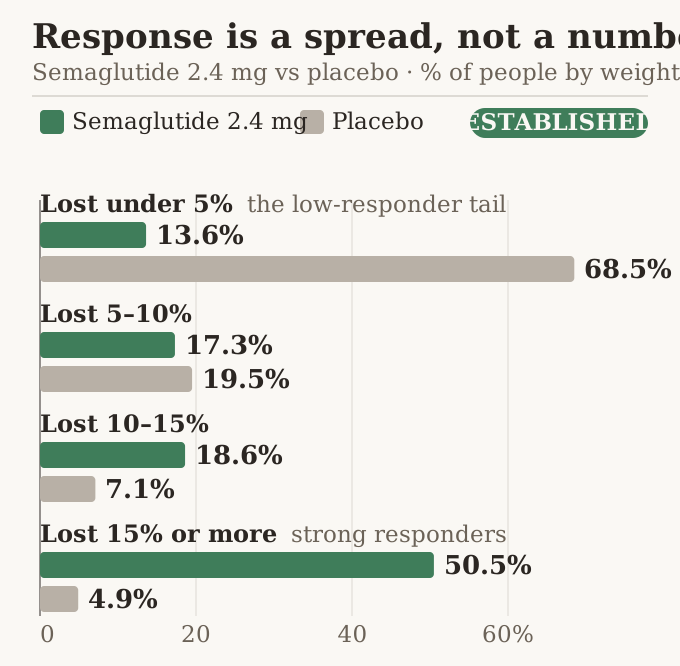
The whole curve makes one point: if the scale barely moved for you, you are not off the chart — you are in that small under-5% group at the left of the distribution. That is a known, named, counted part of how these drugs work — not proof that something is wrong with you.
“It’s not working” is usually one of four things
Here’s where the reframe has to get sharper, because “it’s not working” is four different situations wearing one sentence: judging the drug too early, a plateau after real loss, missed or interrupted doses, and genuine pharmacologic non-response. Only the last one is the drug actually failing.
| What people call “not working” | What’s really happening | Is it drug failure? |
|---|---|---|
| Judged too early | You’re in the first weeks, before reaching and holding the maintenance dose | No — it’s a timing question. See how long a GLP-1 takes to work |
| A plateau after real loss | You lost meaningfully, then the loss stalled — a normal, different pattern | No — the drug worked; see why weight loss plateaus |
| Missed or interrupted doses | Real-world treatment is often stop-start; under-exposure looks like non-response | No — it’s an exposure gap, not a drug gap |
| Genuine pharmacologic non-response | Adequate dose, adequate time, and still essentially nothing | Yes — and it’s the least common of the four |
That table is the whole reframe. The clinic and telehealth pages that top the search results for “ozempic not working for me” tend to collapse all four into one bucket and jump straight to “switch drugs” — which is often the funnel’s entire point. A fair version pulls them apart first, because the fix (or the reassurance) is completely different depending on which one you’re in.
“It’s not working” is four situations wearing one sentence. Three of them aren’t the drug failing at all — they’re timing, a normal plateau, or interrupted treatment. Sort out which before you conclude anything.
Slow starter or true non-responder?
The most useful data on this comes from a post hoc analysis of SURMOUNT-1, the big trial of tirzepatide (a GLP-1/GIP dual agonist — it acts on two gut-hormone receptors rather than one). It followed the people who looked like early non-responders — under 5% lost at week 12 — and asked what became of them.
| Milestone | Share of participants | What it means |
|---|---|---|
| Lost <5% at week 12 | 18% | The “slow starter” group — looks like non-response early |
| Of those, reached ≥5% by week 24 | 70% | Most slow starters catch up within a few more months |
| Of those, reached ≥5% by week 72 | 90% | The great majority get there with continued treatment |
| Still <5% at week 72 | ~1.8% | Genuine non-response, after full exposure — uncommon |
Read the top and bottom rows together. Judged at week 12, nearly one in five looked like a failure. Judged at the end, only about 1.8% of everyone who started the drug truly were — grade supported but limited, since it rests on a single post hoc of one drug, so it’s fair to say “in this analysis,” not “for everyone.” But the shape of the finding is the reassurance: most people who barely respond early are slow starters, not final non-responders. Being in the low tail is common enough to deserve candor and rare enough to deserve a real workup rather than despair.
Why response varies — and why it isn’t willpower
So what actually separates the super-responder from the person in the tail? Increasingly, biology — the parts you didn’t choose. Three factors keep showing up in the data: type 2 diabetes, sex, and common gene variants, each nudging the average response up or down. None of these predict any individual’s outcome; they’re associations with the average, and worth naming precisely because they take the blame off effort.
| Factor | The association with response | Grade |
|---|---|---|
| Type 2 diabetes | Smaller average loss with diabetes (~9.6%) than without (~14.9%); the diabetes trial STEP 2 had 26.8% below 5% vs 7.6% in STEP 1 | Supported but limited |
| Sex | Women lose more on average (~14-16.2%) than men (~8-9.3%) | Supported but limited |
| Common genetics | A GLP1R gene variant is linked to roughly 0.76 kg more loss per copy; genetics + clinical factors explain only ~25% of the variation | Emerging / observational |
That last row is the real anchor. A 2026 genome-wide study of about 27,885 GLP-1 users found real genetic signal — and also found that genetics plus known clinical factors together account for only about a quarter of why people differ. Roughly three-quarters of the variation is still unexplained. (These figures were confirmed through secondary reporting while the primary paper was access-gated, so treat the exact numbers as emerging.) This is not a test to go get; it’s an explanation, not a prediction.
Appetite reduction is the drug’s mechanism — not a reward it hands out for discipline. When genetics, sex, and diabetes status are steering most of the outcome and three-quarters of the difference is still a mystery, “you’re not trying hard enough” isn’t a scientific claim. It’s a guess dressed up as a verdict.
The quiet reason trials beat real life
There’s one more thing hiding inside a lot of “it never worked” stories, and it isn’t the drug. It’s exposure. Trials keep people on medication with high adherence; real life doesn’t.
In a claims-data cohort of 2021 starters with obesity but not diabetes, only 32.3% were still persistent on therapy at one year, and just 27.2% were adherent by the stricter measure — grade observational. Persistence varied a lot by product and has been rising as shortages eased, from 33.2% of starters in 2021 to 60.9% in the first half of 2024 in a larger claims analysis. Much of what gets remembered as “the drug stopped working” is, on the data, interrupted treatment — driven heavily by cost, coverage, and supply, which are system-level facts, not personal ones.
A trial keeps you dosed for a year on purpose. Real life, insurance, and a national shortage do not. Before “true non-response” is even on the table, the plainer question is whether the medicine was actually in your system the whole time.
Saying this is not an accusation. Staying continuously on a medicine for a year, through side effects and pharmacy gaps and insurance letters, is genuinely hard, and the numbers say most people don’t. It just means that “adequate exposure” — the condition for calling anything true non-response — is worth checking carefully before reaching for that label.
Some symptoms aren't something to push through. Severe or persistent abdominal pain, ongoing vomiting or signs of dehydration, or pain high on the right side of the belly are reasons to contact a clinician or seek urgent care — not to tough out for the sake of staying on the drug. Side-effect safety is a separate question from whether the medication is "working," and it always comes first.
When barely-responding is worth a clinician conversation
If you’re in the low tail, the useful next move is not a search bar and not a self-directed change. It’s a specific kind of appointment: a trajectory conversation, not a single number handed across a desk.
What a trajectory conversation actually asks. These are questions for your prescriber to work through with you — not instructions to change anything yourself:
- Have I actually reached and been held at the maintenance dose — and for long enough to judge?
- Have there been missed doses, gaps, or interruptions that lowered my real exposure?
- Is this genuine early non-response, or a slow start that may still catch up?
- Are other medicines, conditions, or life factors interacting with the response?
- If it truly is non-response, what options are on the table — and what are their tradeoffs?
The literature does note that low-responders have a menu to consider — different agents, other approaches — but that menu belongs to a clinician who knows your history, not to a headline or a telehealth ad. Bring your trajectory; leave with a plan, not a panic-switch.
To make the visit sharper, the trajectory-check tool lays out your own numbers against the typical range, so you walk in with a curve instead of a bad Tuesday’s reading. What it won’t do — what nothing here will do — is tell you to raise a dose, change a schedule, or swap one drug for another. Those are prescriber decisions, on purpose.
The honest bottom line
The reassuring half of this is real: barely responding is a counted part of the distribution, most early non-response is a slow start that catches up, and true “adequate drug, adequate time, still nothing” non-response is uncommon. The un-reassuring half is real too: that low tail exists, it isn’t erased by trying harder, and for a small number of people the drug genuinely does little. Both halves are true, and a page that gives you only one of them is selling a headline.
If the scale barely moved, you are not the broken machine on the line. You are a known part of a curve science is still learning to read — and the next honest step is a conversation, not a verdict.
Frequently asked
- How do I know if I'm a non-responder to Ozempic or Wegovy?
- "Non-responder" usually means losing less than 5% of your body weight — but the timepoint matters enormously. A 12-week cutoff flags far more people than an end-of-treatment cutoff, because many slow starters catch up. In the STEP 1 trial, about 7.6% of people lost under 5% counting only those who stayed on the drug — roughly 13.6% if you count everyone who was randomized, whether or not they finished. Same label, two different clocks. Whether you are genuinely one of them is a trajectory question for your prescriber, not a self-diagnosis.
- Is it my fault the medication isn't working?
- No. Response reflects your biology and how much drug you've actually been exposed to, not your effort. Type 2 diabetes status, sex, and common gene variants all shift the average, and genetics plus clinical factors explain only about 25% of the variation between people. Appetite reduction is the drug's mechanism — willpower isn't the lever.
- Should I switch to a different GLP-1 if this one barely works?
- That's a decision for you and a prescriber, never something to do on your own. First rule out judging too early, a plateau after real loss, and missed doses — most "not working" turns out to be one of those. If it is genuine non-response, a clinician has options to discuss. This article does not recommend any specific switch.
- Why did I lose 3% when my friend lost 25% on the same drug?
- Because response is a spread, not one number. In the STEP trials, roughly 1 in 6 to 1 in 10 people lost under 5% while 32-39.6% lost over 20% of their weight. Being on the low end is common enough to be normal and rare enough to be worth a real workup with your clinician.
Sources (7)
Every claim on this page traces to a primary source — and we sell you nothing. No sponsors, no affiliate links, no ads.
- 3 observational studies
- 2 reviews
- 2 randomized trials
More like this