Myths & headlines
'Ozempic teeth': dry mouth, acid & dental risk, graded
"Ozempic teeth" isn't a diagnosis or a labeled side effect — it's a viral name for a chain of plausible oral effects. The GI links are real and measured; the dental damage in actual GLP-1 users has never been counted. Here's each link, graded.
A dentist looks into your mouth, sees the frosted, translucent edges of enamel wearing thin, and asks a question that would have made no sense two years ago: are you on one of the weight-loss shots? By mid-2026 that scene had a hashtag. “Ozempic teeth” spread across TikTok and into the trade press — dry mouth, cracked enamel, sudden cavities, all pinned on the most talked-about medicines in the country.
Here’s the honest problem with the phrase. Every link in the story it tells is plausible. And the one measurement that would turn plausible into proven — do people on these drugs actually lose more enamel than comparable people who aren’t? — has never been taken. This piece walks the chain link by link and grades each one, because almost no one else does.
“Ozempic teeth” isn’t a lie. It’s a chain of real ingredients assembled into a claim that no one has actually measured. That gap is the whole story.
Start here: it’s not a diagnosis
The first fact here is regulatory, and it’s easy to check. No GLP-1 prescribing information — not Wegovy’s, not any of them — lists a dental, tooth, enamel, or dry-mouth adverse effect. The Wegovy label’s adverse-reactions table is full of gut symptoms (nausea, vomiting, reflux, burping, indigestion) and nothing about teeth. Grade: established — this is a check-the-document claim, not a judgment call.
“Ozempic teeth” is a social-media umbrella term, and the dental profession says so plainly. The New York State Dental Association calls the phenomenon patient-reported and unofficial. So we start from the same place a careful clinician would: this is not a recognized condition, and nobody’s label warns of it.
Why "not on the label" matters: a labeled side effect has cleared a bar — it showed up often enough, and consistently enough versus placebo, that a regulator required it in writing. "Ozempic teeth" hasn't cleared that bar. That doesn't make it impossible; it means the evidence is earlier and softer than a headline implies.
The one solid link: vomiting brings acid up
Where the story stops being vague is vomiting. On the Wegovy label, about 24% of adults on semaglutide 2.4 mg reported vomiting, versus 6% on placebo. Nausea ran 44% versus 16%, diarrhea 30% versus 16%. These are randomized controlled trial (RCT)-grade, on-label numbers. Grade: established.
And the dental half of this link is settled science too: stomach acid is acidic enough to soften and dissolve tooth enamel, and repeated vomiting is a classic cause of erosion, well described long before these drugs existed. So the connection vomiting → acid on teeth is real at both ends.
Worth naming plainly: recurrent self-induced vomiting is also a classic cause of this exact erosion pattern, and anyone whose relationship with eating — or with these medicines — feels out of control should talk to a clinician.
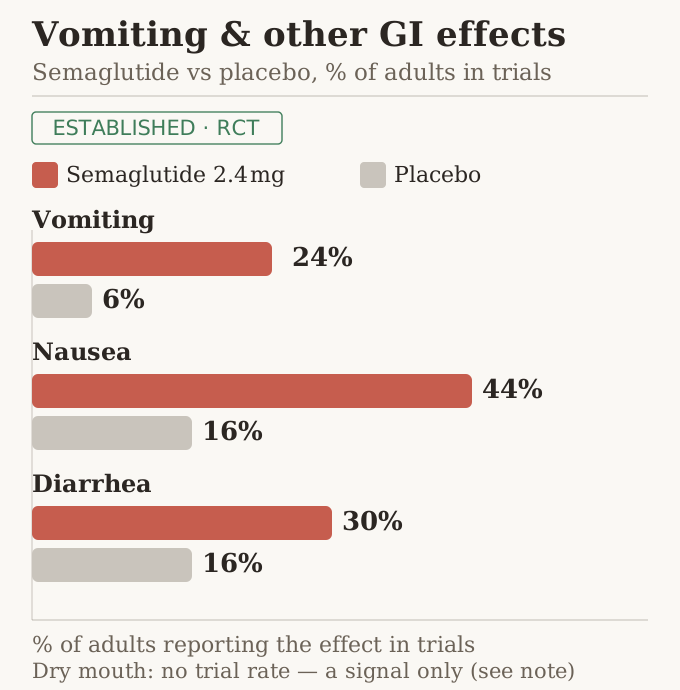
One caveat the label itself supplies: trial vomiting is often transient and concentrated during the dose-escalation weeks, when the medicine is being stepped up. That matters for teeth, because a few rough weeks of occasional vomiting is a different exposure than years of daily acid — and the label describes the former, not the latter.
When vomiting is more than a dental issue: severe or persistent vomiting, or not being able to keep fluids down, is a reason to contact your prescriber or seek care promptly — not just for your teeth. Vomiting can cause dehydration and strain your kidneys, and, less commonly, signal something more serious.
The number that isn’t about you
Now the link that gets abused most. Chronic acid reflux — GERD — is a listed adverse reaction on the Wegovy label (established that it’s listed), and reflux, like vomiting, washes acid over teeth. From there, articles reach for a striking statistic: dental erosion turns up in about 49% of people with GERD versus about 20% of people without it, pooled across ten studies and more than 7,000 patients.
That erosion statistic is real. But read exactly whom it describes: people with chronic reflux disease, studied in dental clinics — not GLP-1 users. No one has measured erosion rates in people on semaglutide. Importing the GERD figure as if it were an Ozempic number is the single most common error in the coverage, and it quietly converts a reflux-population association into a drug effect it was never about. Grade for the reflux-erosion link: supported but limited / observational — a real association among reflux patients, not a causal, GLP-1-specific measurement.
The 49% is a true number about the wrong people. Nobody has counted erosion in actual GLP-1 users — so anyone quoting a percentage for “Ozempic teeth” is borrowing one that isn’t theirs.
Dry mouth: a signal, not a statistic
Dry mouth is the third link, and the one where the evidence is thinnest of all. It is not on the label. Where it shows up is the FDA’s adverse-event reporting system (FAERS) — a voluntary database of things people and clinicians report after the fact. In a pharmacovigilance study of semaglutide — that is, after-the-fact safety monitoring — dry mouth appeared among 17 “new and unexpected” effects not in the labeling, with a weak statistical signal (the disproportionality measure’s lower bound was just 1.63 — a barely-above-baseline blip, nowhere near strong enough to trust). Grade: observational-only / emerging.
A signal like that is a lead for researchers, not a rate. FAERS can’t tell you how many people get dry mouth, can’t prove the drug caused it, and is skewed by whatever people happen to report. The narrative review that examined the biology says as much in plain terms: the dry-mouth signal “cannot confirm causality.”
Ignore the tidy percentage. Some marketing and telehealth blogs claim a specific figure — "3–5% of patients get dry mouth." We could not trace that number to any trial or to the label, and dry mouth isn't in the Wegovy adverse-reactions list at all. When a page gives you a clean percentage for an effect that only exists as a database signal, that's a flag the source is inventing precision it doesn't have.
Why would dry mouth even be plausible? GLP-1 receptors sit in many tissues, and researchers hypothesize that prolonged receptor activation could disturb the signaling that drives salivary flow. But the same review is blunt: there is “no direct experimental confirmation of GLP-1 receptor function in human salivary glands.” So the mechanism is a hypothesis, and saliva’s protective role — it neutralizes acid, clears debris, and carries the minerals that repair enamel — is the only well-established biology in this paragraph. Less saliva plausibly means less protection; whether these drugs meaningfully reduce saliva in people is unmeasured. Grade for the saliva-to-GLP-1 link: speculative / mechanistic.
Four links, four different grades
The reason “Ozempic teeth” feels convincing is that it chains together claims of very different strength and presents them as one. Pulled apart, they don’t grade the same at all.
| The link in the chain | What the evidence actually is | Honest grade |
|---|---|---|
| GLP-1s commonly cause vomiting; vomit exposes teeth to acid | On-label trial rates (vomiting ~24% vs 6%); acid-erodes-enamel is settled dentistry | Established |
| GLP-1s can cause reflux, and reflux is linked to erosion | GERD is a listed reaction; the ~49% vs 20% erosion figure is from reflux patients, not GLP-1 users | Supported but limited / observational |
| GLP-1s cause dry mouth | A weak FAERS signal among effects not on the label; no rate, no causal proof | Observational-only / emerging |
| GLP-1 users measurably develop more cavities and erosion | No controlled human dental-outcome study exists as of 2026 | Anecdotal → emerging; not established |
How to read the table: the top rows are the best-proven; the bottom row — the actual headline claim — is the least supported.
Notice the shape of it. The ingredients on the left are well evidenced. The finished dish on the bottom row — the thing the headline actually claims — has never been cooked. As of 2026 there is no study comparing dental outcomes in GLP-1 users against matched non-users; the strongest oral-health papers are explicitly mechanism-focused and non-causal, and the dental-association coverage rests on mechanism and anecdote. That’s not a reason to dismiss the concern. It’s a reason to size it honestly.
What dentists generally say — as literacy, not a prescription
None of this changes the everyday dental advice that applies to anyone exposed to stomach acid, whether from a stomach bug, morning sickness, reflux, or medication side effects. It’s worth knowing on its own terms.
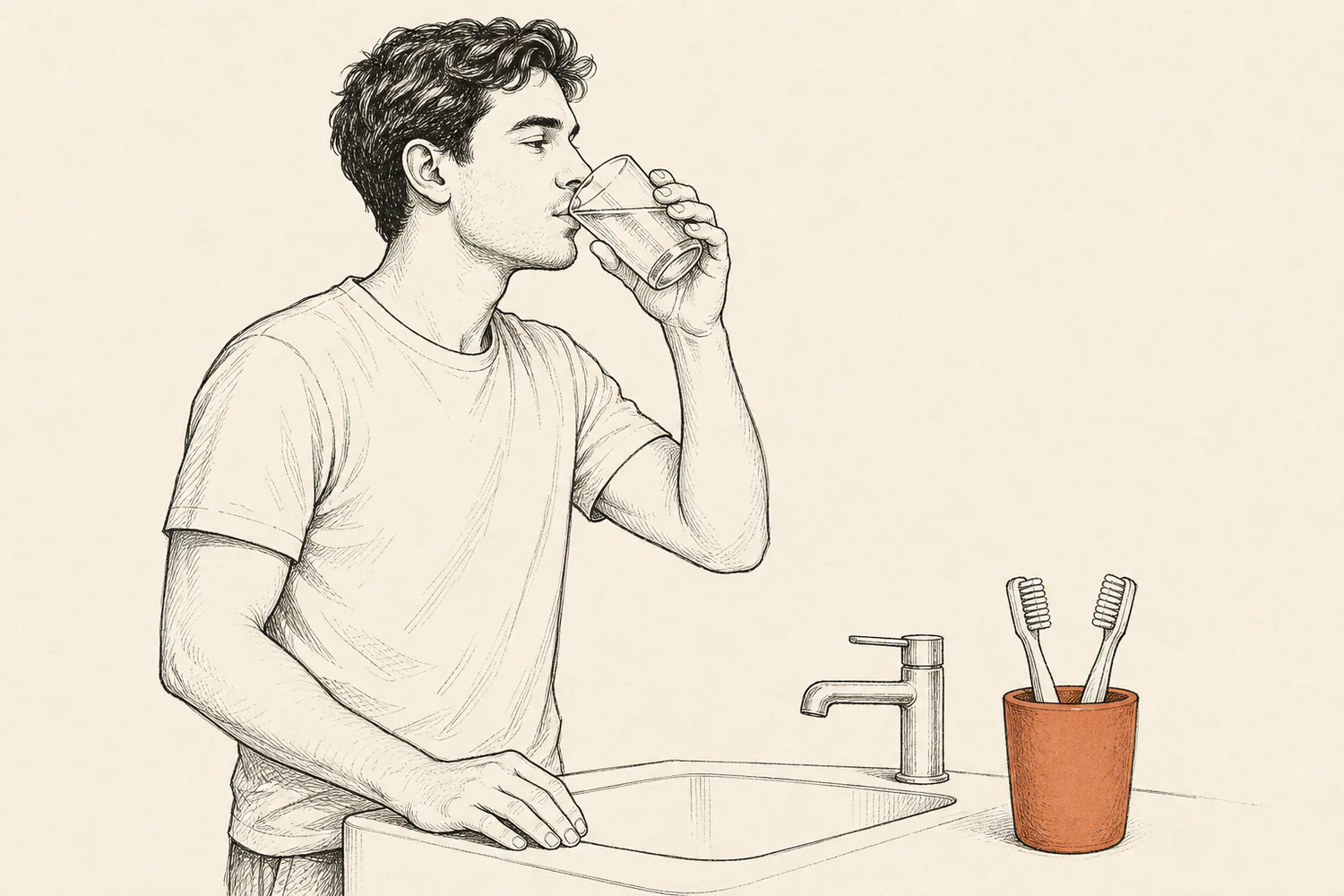
General dental literacy (true for anyone, not advice about your regimen): after vomiting or acid exposure, dentists generally suggest rinsing with plain water — or a water-and-baking-soda rinse — rather than brushing right away, because enamel is temporarily softened and hard brushing can abrade it. Give saliva time to do its job. Stay hydrated. And because enamel does not grow back once it's lost, the emphasis is on prevention and on seeing a dentist if vomiting is frequent — not on rescuing enamel after the fact.
Two guardrails on that. First, it’s education, not a plan for your medication — if GI side effects are rough or persistent, that’s a conversation for your prescriber, not a cue to change your dose on your own. Second, be wary of pages that pivot from this advice into selling you a specific “prescription toothpaste” or dry-mouth product; the useful part is the general habit, not the checkout link.
If you want the fuller picture on the acid side of this, our evidence page on GLP-1s and heartburn or reflux grades that link in more depth, and the Wegovy and Ozempic hubs lay out what each label does and doesn’t say. There’s also a live frontier worth flagging honestly: researchers are studying GLP-1 pathways and gum disease, with anti-inflammatory effects seen in animal models — preclinical, unproven in human dental outcomes, and not a reason to expect a benefit for your teeth either.
The honest bottom line
“Ozempic teeth” is neither a myth to laugh off nor a proven hazard to fear. It’s a real chain of plausible effects — established vomiting rates, general acid-erosion science, a thin dry-mouth signal — assembled into a claim that no one has measured in the people it names. The vomiting is real and worth managing with basic dental habits. The dry mouth is a signal, not a statistic. The scary erosion percentage belongs to a different population. And the sentence that would settle it — GLP-1 users lose more enamel than comparable non-users — is one the evidence simply cannot say yet.
The ingredients are real. The finished measurement isn’t in. Keeping those two facts side by side is the difference between informing you and scaring you.
Frequently asked
- Is 'Ozempic teeth' a real medical condition?
- No. It is not a recognized diagnosis and not a labeled side effect of any GLP-1 drug. No prescribing information lists a dental, tooth, enamel, or dry-mouth adverse effect. The phrase is a viral coinage describing a chain of plausible oral changes — vomiting, reflux, and reported dry mouth — that could, in principle, affect teeth.
- Does Ozempic or Wegovy cause dry mouth?
- Dry mouth appears as a disproportionate report in the FDA's adverse-event database (FAERS) — a weak, hypothesis-generating signal that was flagged among effects not in the label. That means it cannot confirm how often it happens or that the drug causes it. There is no trial-verified dry-mouth rate, so treat any specific percentage you see online with suspicion.
- Do GLP-1 drugs actually damage your teeth?
- As of 2026, no controlled study has measured whether GLP-1 users get more cavities or enamel erosion than comparable non-users. The mechanism is plausible — vomiting and reflux expose teeth to acid, and less saliva removes protection — but plausible is not proven. The strongest oral-health papers are explicitly mechanism-only and non-causal.
- I'm vomiting on a GLP-1 — what do dentists generally advise?
- As universal dental literacy (not advice about your specific regimen): after acid exposure, rinse with water and wait before brushing, because acid-softened enamel abrades easily. Enamel doesn't regenerate once lost. See a dentist if you're vomiting often, and raise persistent GI side effects with your prescriber — never adjust your medication on your own.
- Is the vomiting or dry mouth permanent?
- Trial vomiting is often transient and concentrated during the dose-escalation weeks, per the label. Dry mouth, as a reported signal, isn't well enough studied to say. Enamel loss, if it happens, is the part that is not reversible — which is exactly why the general advice leans preventive.
Sources (8)
Every claim on this page traces to a primary source — and we sell you nothing. No sponsors, no affiliate links, no ads.
- 2 reviews
- 1 FDA labels
- 1 observational studies
- 1 meta-analyses
- 1 guidelines
- 1 other primary
- 1 news / agency
More like this