Myths & headlines
Do GLP-1s cause — or prevent — cancer? What the evidence says
One camp says these drugs cause cancer; another says they prevent it. On today's evidence both overreach: no overall rise, a rodent-based thyroid warning humans haven't confirmed, and early signals of lower risk for some obesity-linked cancers — association, not proof, in every direction.

Type “Ozempic” and “cancer” into a search bar and you’ll be handed two confident, opposite stories. One warns that these drugs cause cancer — pointing at the black-boxed warning on the label. The other promises they prevent it, citing a run of 2024–2026 studies with encouraging headlines. Both stories are selling certainty. Neither has earned it.
The honest version is less satisfying and more useful: there is no single “GLP-1 and cancer” answer, because “cancer” isn’t one question. It’s at least three — thyroid, pancreatic, and the obesity-related cancers — and they sit on three different rungs of the evidence ladder. Pull them apart and the fear shrinks, the hype deflates, and what’s left is a mixed, still-early picture worth understanding.
The two headlines, and why both overreach
Here is the whole argument on one chart: fifteen reported risk ratios for GLP-1 users versus a comparison group, sorted into the three questions. A ratio below 1.0 means lower observed risk; above 1.0 means higher. What jumps out is that most of the confidence intervals cross the no-difference line, the point estimates scatter from 0.53 to 1.78, and one cancer — colorectal — changes direction depending on which study you read.
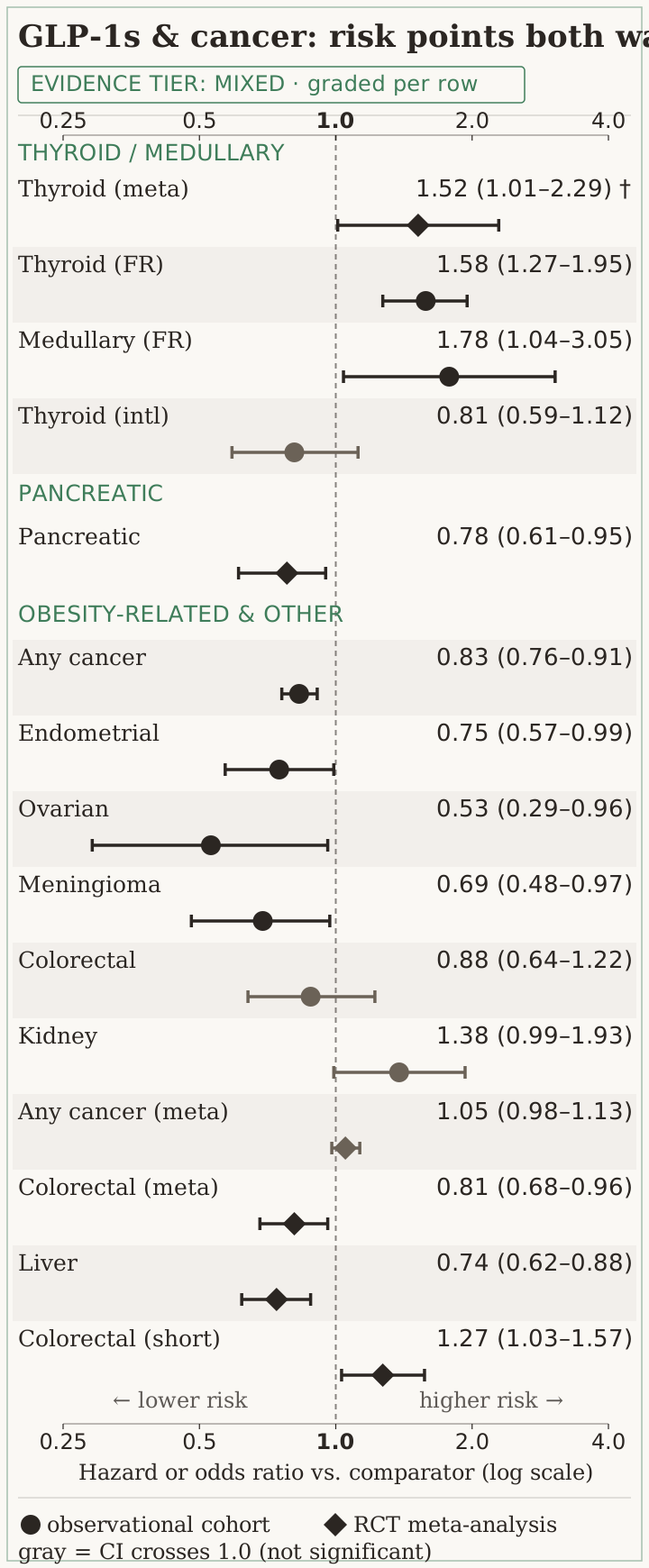
That scatter is the point. When the same medicine looks protective in one dataset and harmful in another, you are almost always looking at association, not proof — patterns shaped as much by study design, follow-up length, and who got compared to whom as by the drug itself. Keep that in your pocket for everything below, including the good news.
Thyroid: a real warning built on rat data
Start with the scary end, because it’s the most legitimate. Semaglutide and tirzepatide labels carry an FDA boxed warning — the strongest kind — for “Risk of Thyroid C-Cell Tumors,” and the drugs are contraindicated in anyone with a personal or family history of medullary thyroid carcinoma (MTC) or the genetic syndrome MEN 2. That is a real, current regulatory fact (label verified July 2026), and it’s well-established as policy.
What most fear-content leaves out is what the warning is made of. Read the label and it tells you plainly: semaglutide “causes dose-dependent and treatment-duration-dependent thyroid C-cell tumors” in rodents, and “it is unknown whether OZEMPIC causes thyroid C-cell tumors, including MTC, in humans, as the human relevance… has not been determined.” In evidence terms, the human version of this claim is preclinical — animal-and-mechanism only.
Why rats aren't small humans here: rodents have far more thyroid C-cells and higher GLP-1-receptor expression than people do, and the C-cell proliferation seen in rats and mice is not reproduced in primates. That's exactly why the warning stays cautious rather than confirmed — the animal finding is a flag to watch, not a demonstrated human effect.
The human data that do exist genuinely conflict, which is why we grade this one disputed/mixed. A 2024 meta-analysis of randomized trials (64 trials retrieved, 26 of them reporting at least one thyroid-cancer case) found a statistically significant increase — odds ratio 1.52 (95% CI 1.01–2.29) — but with a fragility index of 1, meaning a single additional case in the comparison group would have erased the finding entirely. A large 2023 French cohort (Bezin) found a modest rise with 1–3 years of use: all thyroid cancer at a hazard ratio of 1.58 (1.27–1.95), and medullary specifically at 1.78 (1.04–3.05) — though on a very small number of MTC cases, and unable to rule out that GLP-1 users simply get their necks scanned more.
Then the largest, most rigorous human dataset — an international cohort of 98,147 GLP-1 users across six countries — found no increased thyroid-cancer risk at all: hazard ratio 0.81 (0.59–1.12). The authors call it reassuring for short-term use, and admit they can’t speak to the long term.
So the honest thyroid verdict: the boxed warning stands as a sensible precaution and a genuine contraindication your clinician screens for, but there is no confirmed causal MTC signal in humans — the strongest positive signals are fragile or observational, and the biggest cohort is null.
Pancreatic: the scare that already went to trial
If thyroid is the current fear, pancreatic cancer was the original one — the alarm that dominated headlines in the early 2010s. It’s worth knowing how that story ended, because most “cancer” pieces never mention that it did.
In 2014, the FDA and the European Medicines Agency jointly re-examined more than 250 toxicology studies and the trial data, and published their assessment in the New England Journal of Medicine: assertions of a causal link between incretin drugs and pancreatitis or pancreatic cancer were “inconsistent with the current data.” More than a decade later, a 2026 meta-analysis of 93 randomized trials (roughly 1.85 million participants) put pancreatic cancer at a hazard ratio of 0.78 (0.61–0.95) — no increase, if anything a lower point estimate — and a dedicated 2025 cancer meta-analysis found no significant pancreatic effect either.
Reassuring is not the same as protective. “No increase after a decade of scrutiny” is a strong, calming finding. “Prevents pancreatic cancer” is a sentence the data do not support — and one worth resisting even when it’s flattering.
One distinction keeps this clean: acute pancreatitis is not pancreatic cancer. Pancreatitis (inflammation of the pancreas) remains a listed potential risk of these drugs — and it’s worth knowing its warning signs, because it’s the one thing in this article you might actually need to act on: severe, persistent abdominal pain, often high in the belly and radiating straight through to the back, usually with nausea or vomiting. That’s a stop-and-get-seen symptom, not a wait-and-watch one. Pancreatic cancer is a separate question, and on that one the evidence is reassuring — supported-but-limited by the standards of the field.
The good news that isn’t proof yet
Now the hopeful headlines — which are real, repeated, and still not proof. Across 2024–2026, several strong datasets found lower rates of obesity-related cancers among GLP-1 users. The most cited is a 2025 JAMA Oncology target-trial emulation of 86,632 adults with obesity:
| Cancer | Hazard ratio (95% CI) | What it means |
|---|---|---|
| Overall cancer | 0.83 (0.76–0.91) | Lower — statistically significant |
| Endometrial | 0.75 (0.57–0.99) | Lower — just significant |
| Ovarian | 0.53 (0.29–0.96) | Lower — significant, wide interval |
| Meningioma | 0.69 (0.48–0.97) | Lower — significant |
| Colorectal | 0.88 (0.64–1.22) | Trend down — not significant |
| Kidney | 1.38 (0.99–1.93) | Trend up — not significant |
A randomized-trial meta-analysis points the same way for gut cancers — colorectal 0.81 (0.68–0.96), liver 0.74 (0.62–0.88) — though the authors flag cancer as a secondary endpoint and call the results hypothesis-generating. We grade this whole cluster observational-only / emerging: a promising pattern, not established prevention. Notice the kidney row, too — a non-significant increase sitting right beside all the good news, a reminder that a real dataset doesn’t only hand you the results you were hoping for.
The single most honest complication is colorectal cancer. In the meta-analysis above it looks protective (0.81); in a separate 2025 meta of 50 trials it looks harmful in shorter studies — odds ratio 1.27 (1.03–1.57) — which those authors attribute not to biology but to detection: GLP-1 gut side effects send more people for colonoscopy, and colonoscopies find cancers. Same drug class, opposite point estimates, driven by study design. If you want a single picture of why “association, not proof” applies to the good news as strictly as to the bad, that’s it.
Three questions, three grades
Pull it together and the reason the topic generates so much heat becomes obvious: people argue three questions as if they were one, and the three don’t share an answer.
| The question | What the evidence says | Honest grade |
|---|---|---|
| “GLP-1s cause thyroid cancer” | Rodent-based boxed warning; a fragile trial estimate (OR 1.52, fragility index 1) and a modest cohort signal on one side; the largest cohort null (HR 0.81) | Disputed / mixed — no confirmed human MTC signal |
| “GLP-1s cause pancreatic cancer” | 2014 FDA/EMA review called causality “inconsistent with the current data”; recent trial meta-analyses show no increase (HR 0.78) | Reassuring — not shown to cause it |
| “GLP-1s prevent obesity-related cancers” | Repeated signals of lower risk (overall 0.83; endometrial, ovarian, meningioma), but observational, confounded, short follow-up; colorectal even flips | Observational-only / emerging — a hypothesis, not prevention |
The overall-cancer number ties a bow on it: pooled across 50 randomized trials, the odds ratio is a flat 1.05 (0.98–1.13) — no net rise, no net drop. Whatever is happening lives in the specific cancers, not the total.
Why the numbers disagree
Four confounders explain most of the scatter on that opening chart — and knowing them is what turns you from a headline-reader into a claim-checker.
- Detection bias. GLP-1 users see clinicians more and get scanned and scoped more. That can manufacture an apparent excess (short-term thyroid, colorectal) or hide a real signal.
- Comparator choice. A hazard ratio is always “versus something.” Compared with metformin (which some studies associate with lower cancer risk — itself an unproven, confounded claim), GLP-1s can look worse; compared with insulin or a sulfonylurea, better. Direction partly reflects the other drug.
- Weight-loss confounding. Obesity itself raises the risk of roughly 13 cancers (the CDC/IARC figure), so any effective weight-loss drug will show apparent “protection” that may not be a drug-specific effect at all.
- Short follow-up. Cancer latency runs years to decades; most of these datasets cover 1–3 years. That’s the biggest reason no one can yet close the long-term thyroid question.
A medicine can fail to cause cancer, associate with less of some cancers, and still carry an unresolved long-term question — all at once. Populations answered over three years are not the same object as your next forty.
What this means if it’s you
None of the above tells you what will happen in your body, and it isn’t meant to. The practical version is smaller than the science.
Whether to start, stay on, stop, or switch one of these drugs over a cancer worry is a decision to make with a qualified clinician who knows your history — not something to settle from a chart. What’s most useful to bring to that conversation is your own history: a personal or family history of medullary thyroid cancer or MEN 2 is a labeled contraindication prescribers screen for, and it’s worth naming up front rather than assuming it was asked. (For the broader safety picture, see our rundown of GLP-1 side effects and the lesser-known ones.)
Symptoms beat self-diagnosis. You can't feel a hazard ratio, but you can notice a body change. A new lump or swelling in the neck, a hoarse voice that won't clear, or trouble swallowing or breathing are reasons to be seen by a clinician — on or off any medication. Raising them promptly is standard on-label counseling for these drugs, not a sign you've done something wrong.
And when you meet the next confident headline — “causes cancer,” “prevents cancer” — the tell is whether it names its confounders. A piece that quotes the boxed warning without mentioning it’s rodent-based, or the JAMA numbers without mentioning weight-loss and detection bias, is selling a story. You can run any specific claim you’ve seen through our claim checker.
The honest bottom line
On today’s evidence, GLP-1 drugs do not appear to raise overall cancer risk in humans. They carry a precautionary, rodent-based thyroid warning that human data have not confirmed and cannot yet fully rule out for the long term. And they show early, unproven signals of lower risk for some obesity-related cancers — real enough to take seriously, soft enough that “prevents cancer” is a claim the data haven’t earned. Association, not proof, in every direction. The site that gives you only the frightening half and the site that gives you only the hopeful half are making the same move — choosing a headline over you.
Frequently asked
- Do GLP-1s cause cancer?
- On today's evidence, GLP-1 medicines do not appear to raise overall cancer risk in humans — pooled across 50 randomized trials, the overall-cancer odds ratio is a flat 1.05 (95% CI 0.98–1.13). But "cancer" isn't one question. These drugs carry a precautionary thyroid-tumor boxed warning that is based on rodent studies and has not been confirmed in humans; the older pancreatic-cancer scare was judged "inconsistent with the current data" by the FDA and EMA; and there are early, unproven signals of lower risk for some obesity-related cancers. Association, not proof, in every direction — and follow-up so far is short (1–3 years against cancer's long latency).
- Does semaglutide cause cancer?
- Semaglutide (Ozempic, Wegovy) has not been shown to cause cancer in humans. It carries an FDA boxed warning for thyroid C-cell tumors, but the label states that warning is based on rodent studies and that the human relevance is "not determined" — and the largest human cohort of GLP-1 users (98,147) found no increased thyroid-cancer risk (hazard ratio 0.81), reassuring though observational. Across 50 randomized trials, overall cancer risk was not raised (odds ratio 1.05). The honest limit is time: most data cover only 1–3 years, and cancer develops over years to decades.
- Can retatrutide cause cancer?
- Retatrutide has no established human cancer signal — but that partly reflects how little long-term data exist for a drug still in trials (it is investigational and not FDA-approved), not a clean bill of health. Because it acts on the GLP-1 receptor, the same rodent-based thyroid C-cell caution seen across this drug class is generally expected to apply — the kind of history (personal or family medullary thyroid cancer, or MEN 2) that clinicians already screen for across approved GLP-1 medicines, and would be expected to for retatrutide if it is approved. Treat confident "retatrutide causes — or prevents — cancer" claims with the same caution as for the rest of the class: the follow-up simply isn't long enough yet to know, and whether it's ever right for you is a decision for a qualified clinician, not a website.
- Does Ozempic cause thyroid cancer?
- It has not been shown to cause thyroid cancer in humans. The FDA boxed warning is based on rodent studies, and the label states the human relevance is "not determined." Human data conflict: a randomized-trial meta-analysis found a statistically significant but extremely fragile increase (one extra case would erase it), a French cohort found a modest rise, and the largest international cohort (98,147 users) found no increased risk. On balance there is no confirmed causal signal in humans — but follow-up so far is short.
- Why is there a cancer warning on the label if the human studies are reassuring?
- Because the warning is precautionary and rooted in animal data. Rodents develop dose-related thyroid C-cell tumors on these drugs, and rodents have far more C-cells and higher GLP-1-receptor expression than humans, so the effect doesn't clearly translate. Regulators kept the warning — and the contraindication for people with a personal or family history of medullary thyroid cancer or MEN 2 — as a safeguard while long-term human data accumulate.
- Do GLP-1s prevent cancer?
- No — that overstates the evidence. Several 2024–2026 studies show lower rates of some obesity-related cancers among users, which is encouraging. But these are observational or secondary findings, heavily confounded by the weight loss itself, by how often users get screened, and by which drug they were compared against. It's a promising hypothesis, not established prevention.
- What's the difference between pancreatitis and pancreatic cancer here?
- They are different things and shouldn't be blurred. Acute pancreatitis (inflammation) is a listed potential risk of these drugs. Pancreatic cancer is a separate question — and the 2014 FDA/EMA review found the causal claim "inconsistent with the current data," with recent trial meta-analyses showing no increase. A scare about one is often quoted as if it settled the other; it doesn't.
- I have thyroid nodules or a family history — can I take a GLP-1?
- That's a conversation for your prescriber, not a website. A personal or family history of medullary thyroid carcinoma or MEN 2 is a labeled contraindication these drugs' prescribers screen for. Nodules are common and mostly unrelated, but they're exactly the kind of history to name up front so the right screening happens. New neck lump, hoarseness, or trouble swallowing while on treatment is a reason to be checked.
Sources (10)
Every claim on this page traces to a primary source — and we sell you nothing. No sponsors, no affiliate links, no ads.
- 3 meta-analyses
- 3 observational studies
- 3 reviews
- 1 FDA labels
More like this