Living with it
Is Ozempic making my hair fall out? The honest answer
Is Ozempic making my hair fall out? The honest answer
Hair in the drain after starting a GLP-1 is real, and it's right there on the FDA label — but at low single-digit rates, and it's almost certainly telogen effluvium: the temporary shedding that follows any fast weight loss and usually regrows. Here's the honest, graded picture.
You notice it in the shower first — a few more strands than usual wrapped around your fingers. Then it’s the pillow, the brush, the dark thread of hair circling the drain. You’ve been on Ozempic (or Wegovy, or Zepbound) for a couple of months, the weight is finally moving, and now this. So you type the question half the internet has typed: is the drug making my hair fall out?
The honest answer is yes — and also, not in the way the scariest headlines imply. More people shed hair on these drugs than on placebo; that part is real and it’s printed on the FDA label. But the rate is low, the cause is almost certainly your weight loss rather than the molecule poisoning your follicles, and the pattern behind it is the most reversible kind of hair loss there is. All of that can be true at once, and the sites that tell you only the calming half are doing the same thing as the ones that scream “Ozempic baldness epidemic”: choosing a headline over you.
Yes, more people lose hair on these drugs than on placebo. No, it is not the drug attacking your hair — and no, for most people, it is not permanent.
How common is it, really?
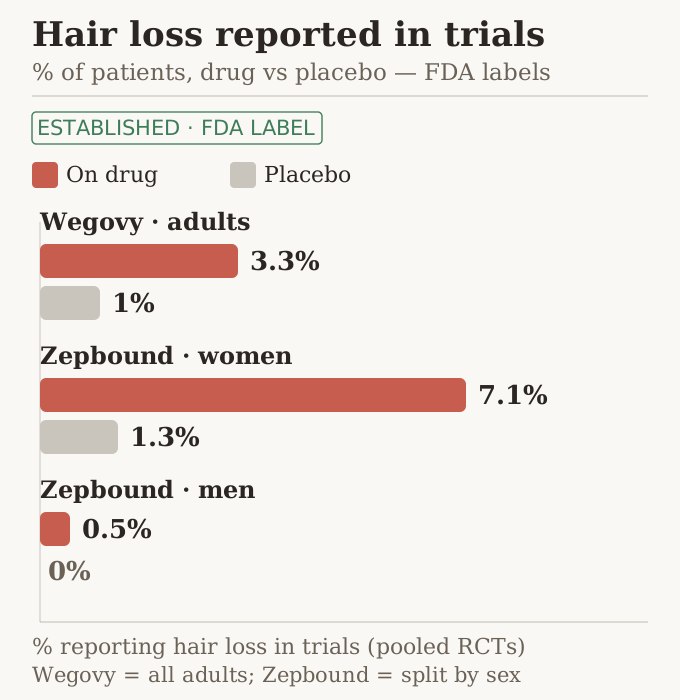
Start with numbers instead of vibes. On Wegovy (semaglutide 2.4 mg), hair loss was reported by 3.3% of adults versus 1% on placebo in the pooled trials. On Zepbound (tirzepatide), it skewed strongly female: 7.1% of women versus 1.3% on placebo, and just 0.5% of men versus 0%. These are adverse-reaction rates straight from the FDA prescribing information — about as solid as safety data gets, so we grade the existence of the effect established.
Flip that around and the reassurance is built into the same numbers: in the trials, roughly 93 to 97 out of every 100 people did not report hair loss at all. It’s a real effect, and it’s an uncommon one.
It’s the weight loss, not the molecule
Here’s the most useful and least-quoted fact in this whole conversation, and it comes straight from the regulator, not from us. Both the Wegovy and Zepbound labels say the hair-loss reactions were “associated with weight reduction.” Not “caused by an unknown drug effect.” Associated with losing weight.
The label's own words: the FDA's adverse-reaction section attributes the shedding to weight reduction, not to the drug chemically attacking your follicles. And the effect tracks the size of the loss — Canada's Wegovy product monograph reports about 5.3% hair loss in people who lost 20% or more of their body weight versus 2.5% in those who lost less. (That gradient is product-monograph data reported secondhand — grade it supported but limited, not primary trial evidence.)
That association matters because it points at a mechanism with a name and a long, well-understood track record: telogen effluvium. It’s the temporary “stress shedding” that follows crash dieting, bariatric surgery, high fever, major illness, and childbirth. Any big physiological jolt — and dropping weight fast is a big one — can push a wave of follicles out of their growing phase and into their resting phase early. A couple of months later, those resting hairs let go all at once. It looks alarming in the drain, but the follicle isn’t damaged; it’s been reset.
Telogen effluvium isn’t your follicles dying. It’s your follicles taking an unscheduled break — the same break they take after childbirth or a crash diet — and then going back to work.
We grade the telogen-effluvium explanation supported but limited. The underlying physiology is textbook and the fast-weight-loss link is well established; what’s still thin is GLP-1-specific documentation. The scoping review that characterized subtypes — nine studies plus more than a thousand FDA adverse-event reports — found telogen effluvium and androgenetic (pattern) alopecia to be the most commonly reported, but stated plainly that “a causal relationship cannot be confirmed.” Honest frontier: the signal is real, and the mechanism is overwhelmingly weight-loss-driven.
One subtlety worth naming: a rapid-weight-loss telogen effluvium can also unmask or accelerate androgenetic (pattern) hair loss — the progressive, genetically driven thinning that, unlike telogen effluvium, does not reliably regrow on its own. So scope the reassurance carefully: the telogen-effluvium component regrows, but any pattern loss it exposes may not. That’s exactly why “hair that isn’t regrowing once your weight stabilizes” sits on the see-a-dermatologist list below.
Three claims people mash into one
Most of the confusion online comes from arguing three different questions as if they were the same one. Pulled apart, they don’t even get the same grade. Spoken aloud: the first claim — that these drugs list hair loss as a side effect — is established, straight from the FDA labels. The second — that the drug is chemically attacking your follicles — is not established, because the labels pin the shedding on weight reduction, not on proven follicle toxicity. The third — that it’s temporary and grows back — is supported but limited: reassuring by analogy to bariatric surgery, but not yet proven for these drugs. The table lays the same three out side by side.
| The claim | What the evidence says | Honest grade |
|---|---|---|
| “These drugs list hair loss as a side effect” | Yes — 3.3% vs 1% (Wegovy) and 7.1% vs 1.3% in women (Zepbound), from the FDA labels | Established |
| “The drug is chemically attacking your follicles” | The labels attribute it to weight reduction; a scoping review says a drug-specific causal effect “cannot be confirmed” | Emerging / not established — mechanism is weight loss, not proven follicle toxicity |
| “It’s temporary and grows back” | Definitional for telogen effluvium, and near-complete regrowth is typical in the bariatric analog; not yet systematically documented for GLP-1s | Supported but limited — reassuring by analogy, not yet proven for these drugs |
Notice how the middle row deflates the fear and the bottom row supports the hope — and neither one lands as the slam dunk the headlines are after.
The timeline that should stop the week-2 panic
A lot of people spiral at exactly the wrong moment. Telogen effluvium is a delayed reaction: the shedding classically shows up two to three months (sometimes up to four) after the trigger, not on the first injection. In the bariatric telogen-effluvium literature, acute shedding tends to appear within the first three months of rapid loss and then resolves — one documented case reached near-complete regrowth around 14 months post-surgery.
The shedding you see in month three is an echo of the stress your body registered in month one. By the time hair is coming out, the follicles are often already cycling back in.
So the shed itself is usually a lagging indicator, not a sign that something new is going wrong today. Grade: supported but limited — this is the classic telogen-effluvium timeline, borrowed from the closest studied analog rather than measured directly in GLP-1 trials.
What actually helps — and what doesn’t
This is where we can be genuinely useful without crossing into advice we have no business giving. There is exactly one lever here with real biological grounding, and it isn’t a serum.
Nutrition is the modifiable piece. When you're eating far less, protein and micronutrients like iron and zinc can fall short, and deficiency is an established co-driver of shedding during rapid weight loss (in the bariatric literature, one case of zinc-linked shedding regressed with repletion). Making sure you're getting adequate protein and nutrients while losing weight is a reasonable, non-drug thing to raise with your clinician or dietitian.
What we won't tell you to do: take a specific supplement dose, or slow your medication down to save your hair — those are individual medical decisions. One caution worth knowing: high-dose biotin isn't a proven fix for telogen effluvium and can interfere with lab tests, including thyroid and troponin (heart) assays — a problem the FDA flagged in a safety communication issued in 2017 and updated in 2019. Supplement choices belong with a clinician who can check what you actually need.
And a note on pace: because the shedding tracks how fast and how much weight comes off, the speed of your weight loss is a legitimate thing to discuss with your prescriber — not a dose to secretly tinker with on your own.
When it’s not just shedding
Telogen effluvium is diffuse — a general thinning all over, more hair in the drain, no bald patches. Some patterns don’t fit that picture, and those are the ones that deserve a real diagnosis rather than reassurance from an article.
See a dermatologist if you notice: distinct patchy or bald spots (not diffuse thinning); a scalp that's red, scaly, scarring, or painful; shedding that keeps getting worse past about six months; or hair that simply isn't regrowing once your weight has stabilized. These patterns point away from simple telogen effluvium and toward conditions — including scarring alopecias — that need treatment early, because scarring loss can be permanent if it's ignored.
Also worth checking, not self-testing: new or persistent unexplained shedding is a reasonable prompt to ask your clinician for a basic look at thyroid function and iron/ferritin. These are common, treatable, and easy-to-miss non-drug causes of hair loss — a quick conversation with your clinician, not a home lab kit.
One more population flag: on the labels, the shedding was consistently more common in women, and it’s been reported as somewhat higher in adolescents (Wegovy is approved from age 12), consistent with the larger weight loss in younger patients. We don’t have a clean, primary-verified adolescent rate to print, so treat that as a soft observation rather than a hard number.
The honest bottom line
“It’s the weight loss, not the molecule attacking your hair” — and the telogen-effluvium component regrows, even if any pattern loss it unmasks may not. That’s the sentence that beats both the clinic that shrugs it off and the clickbait that says you’re going bald.
If you’re finding more hair than usual after starting a GLP-1, you’re not imagining it, and you’re not being vain for caring. But the fuller truth is calmer than the search results suggest: this is the most reversible kind of hair loss, it’s driven by how fast you’re losing weight rather than by the drug savaging your scalp, and for the large majority of people it’s a temporary phase that regrows once the body settles. Watch it, feed yourself well, know the red flags that send you to a dermatologist — and if you want to double-check something scary you read, run it through our claim checker or read the graded rundown on the GLP-1 hair-loss evidence page before you panic-quit a medicine that’s working.
Evidence current as of July 8, 2026. This article is educational and not medical advice; decisions about any medication belong between you and a qualified clinician. The Peptide Era has no commercial stake in any drug, supplement, clinic, or hair product.
Frequently asked
- Will my hair grow back after the weight loss slows down?
- For the shedding pattern behind most GLP-1 hair loss — telogen effluvium — regrowth is the rule once the trigger passes, because the follicles are pushed into resting, not destroyed. In one documented bariatric-surgery case — the best-studied fast-weight-loss analog — near-complete regrowth came around 14 months. We grade this supported but limited: it's strong by analogy and definition, but reversibility hasn't yet been documented systematically for GLP-1s specifically.
- Should I stop taking Ozempic because my hair is thinning?
- That's a decision for you and your prescriber, not a webpage. The population-level pattern is reassuring: the shedding is usually temporary and self-limited. Stopping or changing pace is a real conversation to have — especially because the shedding tracks how fast and how much weight you lose — but it's a clinician's call with your history in front of them.
- Does biotin fix it?
- Biotin is not a proven fix for telogen effluvium, and high-dose biotin can interfere with lab tests — including thyroid and troponin (heart) assays — which can mislead your care. What has real biological grounding during rapid weight loss is adequacy of protein and micronutrients like iron and zinc. Any supplement decision belongs with a clinician who can check what you actually need.
- Why does it seem to hit women more than men?
- The labels show a real skew: on Zepbound, hair loss was reported by 7.1% of women versus 0.5% of men. Part of that likely reflects who lost the most weight and baseline differences in hair patterns, but it isn't fully explained. It's an honest open question, not a settled mechanism.
- Is this permanent, like going bald?
- For most people it's not scarring or permanent baldness. Telogen effluvium is non-scarring shedding that regrows. Permanent, patchy, or scarring loss is a different problem — and the reason the red-flag list below sends you to a dermatologist rather than waiting it out.
Sources (7)
Every claim on this page traces to a primary source — and we sell you nothing. No sponsors, no affiliate links, no ads.
- 3 reviews
- 2 FDA labels
- 1 guidelines
- 1 other primary
More like this