Myths & headlines
Nature's Ozempic? Berberine, gelatin water & fibermaxxing, graded
Berberine, gelatin water, and fibermaxxing get sold as 'nature's Ozempic.' None of them is a GLP-1. The best trials put them somewhere between zero and a couple of pounds — against roughly 15–20% for the drugs. Here's each viral claim, graded.
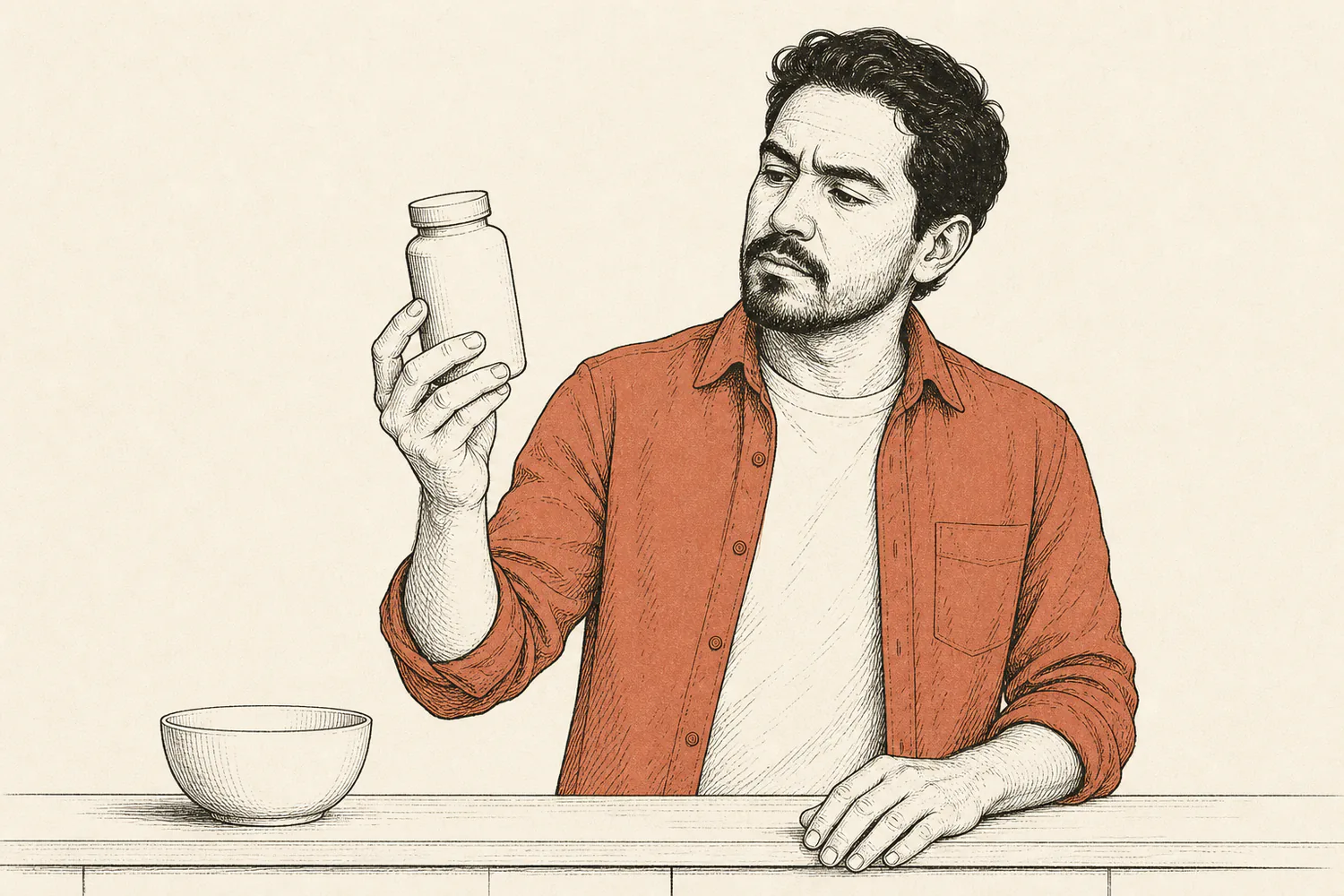
Open the app of your choice and watch someone stir a rust-colored powder into a glass of water and call it “nature’s Ozempic.” Next video: a spoonful of vinegar before lunch. Next: a wobbling cup of “gelatin water.” Next: a plate mounded with fiber, captioned fibermaxxing. The pitch underneath all of them is the same — that a cheap thing on a shelf does what the injectable does, without the prescription, the needle, or the price.
It’s an appealing story. It’s also, mostly, a category error. These substances aren’t fake, and a few of them nudge the scale a little. But the phrase doing all the work — natural GLP-1 — is marketing, not pharmacology. So let’s do the thing the affiliate listicles won’t: put each claim next to its actual evidence, grade it plainly, and measure it against the drug it’s named after.
The gap the listicles bury
Start with the honest yardstick. In two large, blinded, placebo-controlled trials, semaglutide (the molecule in Wegovy and Ozempic) produced about 14.9% body-weight loss (STEP 1, 68 weeks) and tirzepatide (a dual GIP/GLP-1 receptor agonist, sold as Zepbound and Mounjaro) about 15% to 20.9% depending on dose (SURMOUNT-1, 72 weeks). Those are the medicines. That evidence is established — big trials, blinding, placebo controls, thousands of people.
Now the “naturals.” Across their best human trials, the whole group lands between roughly 0 and 2 kg (about 0–4 lb) of weight change — and several of those pooled estimates aren’t statistically distinguishable from zero. Put it in one unit to make the gap concrete: for a 100 kg (220 lb) adult, that’s on the order of 15 kg from semaglutide versus, at very best, about 2 kg from a supplement — and often nothing you could tell apart from zero. That’s not a rounding error.
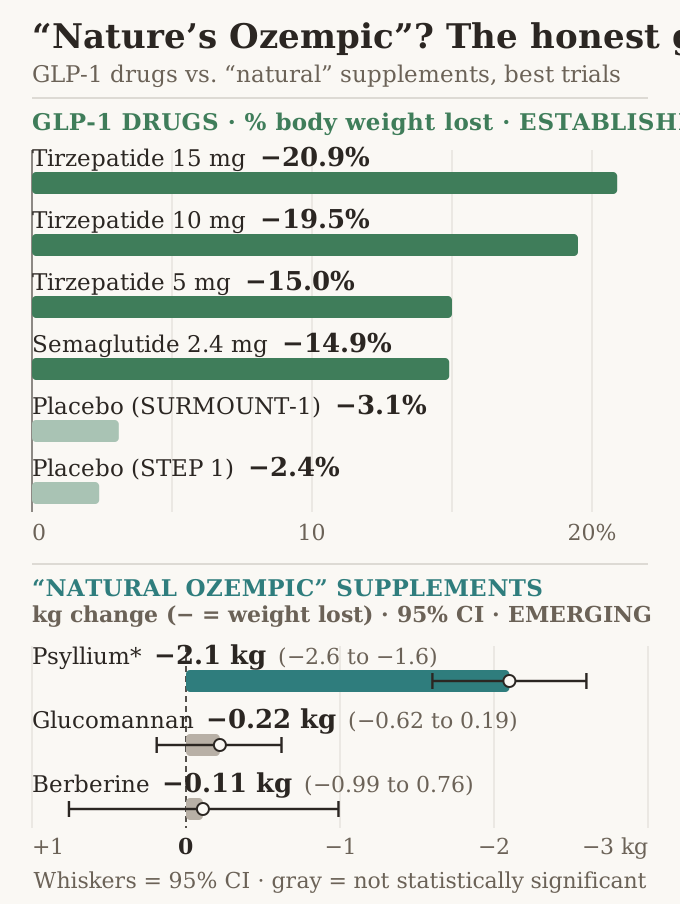
None of these substances touches the GLP-1 receptor. Whatever they do, they do it somewhere else, and far more gently. “Natural Ozempic” isn’t a weaker version of the drug — it’s a different thing wearing the drug’s name.
Berberine, the flagship “natural GLP-1”
Berberine is the one that started the trend, and it’s the clearest test case. It’s a plant alkaloid — a real compound with real biology. But it is not a GLP-1 receptor agonist. It doesn’t bind or activate the GLP-1 receptor. Its most-studied mechanism is activating AMPK, a cellular “energy sensor,” along with shifts in gut bacteria — a pathway that has nothing to do with the incretin signaling the drugs use. On the pharmacology, the equivalence claim is simply false; that berberine works through a distinct mechanism is established.
Does it cause weight loss? Here the grade is emerging — real but small, from low-quality trials. A 10-trial meta-analysis found:
| What was measured | Pooled effect | Statistically significant? |
|---|---|---|
| Body weight | −0.11 kg (95% CI −0.99 to 0.76) | No — the interval crosses zero |
| BMI | −0.29 kg/m² (95% CI −0.51 to −0.08) | Yes, but small |
| Waist circumference | −2.75 cm (95% CI −4.88 to −0.62) | Yes, but small |
A more recent meta-analysis pointed the same direction (waist about −3.27 cm; BMI about −0.435 kg/m²) — and its authors’ own conclusion was a call for “more high-quality, rigorously designed RCTs.” Translation: a BMI drop of roughly 0.3–0.4 kg/m² is about 2–3 lb for a typical adult. Real, measurable, and a long way from what people mean when they say “Ozempic.”
And the fat-burning mechanism everyone cites? The AMPK activation, the increased fat oxidation, the microbiome shifts — those are demonstrated largely in mice and in cells. That’s preclinical evidence: a plausible story about why it might work, not proof that it does in humans. Mechanistic plausibility is not a clinical result.
Gelatin water vs. glucomannan: the substance-confusion problem
Here’s a tell that a trend is running on vibes: the substances get confused with each other. “Gelatin water” and glucomannan both make water thick and jiggly, so people treat them as one thing. They’re not.
“Gelatin water” is animal gelatin — a protein. A packet is roughly 6 grams of protein and 23 calories. Whatever mild appetite effect it has is the perfectly ordinary satiety of eating a little protein before a meal, an effect any protein or fiber preload shares. No trial shows “gelatin water” itself drives durable weight loss. For the specific viral claim, the grade is anecdotal — a plausible nudge dressed up as a hack.
Glucomannan is a gel-forming fiber from konjac root — a genuinely different substance, and one with actual trials. The strongest review of it (8 RCTs) found a body-weight change of −0.22 kg (95% CI −0.62 to 0.19), not statistically significant, and concluded that the available evidence “does not show that glucomannan intake generates statistically significant weight loss.” Some later analyses squeeze out a slightly larger number, but the picture is mixed and dose-dependent at best. Grade: emerging, and effectively null in the most careful read.
One real safety note on any bulk-forming fiber — psyllium or glucomannan: take it with plenty of water. Swallowed dry, or by someone with trouble swallowing or a narrowed gut, these gels can swell before they go down and cause choking or a blockage. It’s rare, but it’s the reason fiber supplements carry a “take with adequate fluid” warning.
Watch the switch. When a supplement's marketing borrows evidence from a different substance — protein "gelatin water" leaning on fiber trials, or any of these leaning on a GLP-1 drug's numbers — that's the moment to slow down and ask what was actually studied. The label and the study often aren't describing the same thing.
Fibermaxxing (psyllium) and the funding footnote
“Fibermaxxing” — piling on fiber, usually psyllium — is the trend with the most flattering headline number and the biggest asterisk.
The eye-catching figure comes from a 2023 review reporting −2.1 kg of body weight across 6 trials. The asterisk: all three authors are employees of Procter & Gamble, which makes a psyllium fiber brand. That’s a conflict of interest worth naming out loud — not because it makes the number fake, but because independent evidence is weaker. A separate 22-trial systematic review found no significant independent effect on body weight at all.
So the honest read on fiber is the boring, useful one: it can modestly support satiety and help you hold a calorie deficit. That’s worth something. It is not a fat-loss lever in the same universe as a GLP-1 drug. Grade: emerging but conflicted — the biggest number carries the biggest conflict.
The most flattering study of a supplement is often the one paid for by the people selling it. That’s not a reason to sneer — it’s a reason to read the author line before you read the headline.
Apple cider vinegar, honestly measured
ACV has the best-looking recent meta-analysis of the bunch — and it’s a useful lesson in reading one carefully. A 2025 review of 10 trials (789 people, mostly adults with overweight or type 2 diabetes) found a small effect: body weight SMD −0.39, BMI SMD −0.65, waist SMD −0.34. “SMD” is a standardized effect size, not pounds — in plain terms, a pound or two at most, and even that is shaky — and the raw-kilogram figures some outlets quote are inflated by how different the studies were from each other.
To their credit, the study’s own authors flagged the problems: high heterogeneity (the trials disagreed a lot), funnel-plot asymmetry suggesting publication bias (unflattering results may be missing), and very short trials, 4 to 12 weeks. The proposed mechanisms — slower stomach emptying, a bit of satiety — are preclinical and plausible, not proven drivers. Grade: emerging, low-certainty. A small effect, on a short horizon, measured with wide error bars — and when a study’s own authors warn you about publication bias and 12-week horizons, that’s worth believing before the headline that skipped those lines.
It’s also not risk-free: acidic vinegar can erode tooth enamel and irritate the esophagus (especially taken undiluted), and it can interact with insulin, diuretics, and some heart medicines. Small possible upside, real small downsides.
The part the affiliate links leave out
Two facts don’t appear in the “buy this” videos, and both matter more than any single effect size.
First, the pharmacology, stated plainly and graded established: not one of these substances is a GLP-1 mimetic. Berberine, fiber, gelatin, vinegar — none acts on the GLP-1 receptor. Claims that a supplement “boosts your own GLP-1” describe, at most, an indirect and clinically trivial effect next to what receptor agonism does.
Second, the regulation. Under U.S. law — the Dietary Supplement Health and Education Act, DSHEA, 1994 — the FDA does not approve dietary supplements for safety or effectiveness before they go on sale. The manufacturer is responsible for safety and truthful labeling; the FTC separately requires that ad claims rest on “competent and reliable scientific evidence.” In practice, that means what’s on the label and what’s in the bottle don’t always match, and undisclosed ingredients turn up in weight-loss products. This is a regulatory fact, current as of 2026, not a knock on any one brand.
Berberine is not a free swap for a prescription. Berberine lowers blood sugar itself, and a specialist drug-interaction reference (Memorial Sloan Kettering's herb monograph) notes it can interact with diabetes medicines — for example, altering how sulfonylureas are handled — and can reduce the activity of drugs your liver clears through its CYP2D6, 2C9, and 3A4 enzymes. Those are real reasons to involve a pharmacist, not theoretical ones. The same reference says berberine should be avoided in pregnancy and while breastfeeding: it can worsen a newborn's jaundice and, in severe cases, push bilirubin high enough to risk kernicterus (brain injury). If you take any prescription medication — especially a diabetes or GLP-1 drug — or you're pregnant or nursing, treat berberine as something to clear with your clinician and pharmacist first. "Natural" does not mean "no interactions."
The honest bottom line
Grade them side by side and the “natural Ozempic” story collapses into something quieter and more useful:
| The viral claim | What the evidence actually shows | Honest grade |
|---|---|---|
| Berberine is “nature’s Ozempic” / a natural GLP-1 | It’s not a GLP-1 agonist; different mechanism (AMPK + microbiota) | False as an equivalence |
| Berberine causes meaningful weight loss | Small BMI/waist drops; body-weight effect not significant; low-quality trials | Emerging |
| “Gelatin water” curbs appetite and melts fat | It’s ~6 g protein; generic satiety, no weight-loss trials | Anecdotal |
| Glucomannan drives weight loss | −0.22 kg, not statistically significant in the strongest review | Emerging → effectively null |
| Fibermaxxing (psyllium) drives fat loss | Best number (−2.1 kg) from a P&G-employee review; independent reviews weaker | Emerging, conflicted |
| Apple cider vinegar causes weight loss | Small effect; short trials, high heterogeneity, publication-bias flag | Emerging, low-certainty |
| Semaglutide / tirzepatide weight loss | −14.9% and −15% to −20.9% in large blinded RCTs | Established |
None of this means the supplements are worthless — fiber and protein have their place, and “small and real” beats “zero.” It also doesn’t mean the drugs are a free lunch: they’re far more effective, but they’re prescription medicines with their own side effects, monitoring needs, and cost. Different trade-off, not no trade-off. What’s false is the comparison being sold to you. A few pounds, sometimes, measured badly, on a short clock, is not 15 to 20 percent of your body weight under trial conditions. If you want to understand what the actual medicines do — and how the two leading ones differ — read the head-to-head on semaglutide versus tirzepatide. And the next time a video calls a powder “nature’s Ozempic,” you can run the claim through the checker instead of the algorithm. The naming is the trick. The evidence is the tell.
This article is educational and describes what the evidence shows. It is not medical advice, contains no doses, and recommends no product or purchase. In the interest of the same honesty we asked of that psyllium study: this site covers GLP-1 medicines and the book behind them, and takes no money from supplement or drug sales — no affiliate links, no sponsors. Decisions about supplements, medications, or combining the two belong between you and a qualified clinician or pharmacist — especially if you take prescription medicine.
Frequently asked
- Is berberine really 'nature's Ozempic'?
- No. Ozempic (semaglutide) is a GLP-1 receptor agonist — it activates the body's incretin signaling. Berberine is a plant alkaloid that works through a different pathway (an energy-sensing enzyme called AMPK, plus gut-microbiota changes) and does not act on the GLP-1 receptor at all. Calling it "nature's Ozempic" is a marketing hook, not a pharmacological fact.
- How much weight can you actually lose on berberine?
- Less than the headlines suggest. In a 10-trial meta-analysis, berberine's pooled effect on body weight was −0.11 kg and not statistically significant; it did modestly lower BMI (about −0.3 kg/m²) and waist circumference (about −2.75 cm). For comparison, semaglutide produced about 15% and tirzepatide about 20% body-weight loss in large trials. The evidence is graded emerging — real but small, and from short, low-quality studies.
- Does apple cider vinegar work for weight loss?
- The evidence is emerging and low-certainty. A 2025 meta-analysis of 10 trials found a small effect on body weight and BMI, but the authors themselves flagged high variability between studies, signs of publication bias, and very short trials (4–12 weeks). Small and short-term is the honest read — not a substitute for a medicine.
- Can I take berberine while I'm on Ozempic or a diabetes medication?
- That's a question for your clinician and pharmacist, not the internet. Berberine lowers blood sugar itself and can interact with diabetes medicines and with drugs your liver clears through its CYP enzymes — a real safety flag, not a where-to-buy note. (It's also one to avoid in pregnancy and breastfeeding.) Don't stack it onto a prescription regimen without professional review.
- Is 'gelatin water' a GLP-1 or an appetite hack?
- Neither, really. The viral "gelatin water" is animal gelatin — a protein — not the konjac fiber (glucomannan) it's sometimes confused with. A packet is roughly 6 g of protein and 23 calories, so any appetite effect is the ordinary satiety of eating protein before a meal, graded anecdotal for weight loss. It does nothing to the GLP-1 receptor.
Sources (14)
Every claim on this page traces to a primary source — and we sell you nothing. No sponsors, no affiliate links, no ads.
- 6 meta-analyses
- 2 randomized trials
- 2 reviews
- 2 guidelines
- 1 other primary
- 1 news / agency
More like this