Myths & headlines
"Ozempic personality": what GLP-1s really do to your mood
In 2026 the FDA removed the suicide warning from these drugs — and separately, people online describe going flat, numb, or joyless on them. Both things are true at once. Here's how to hold them together honestly.

For a year, the scariest word attached to these drugs was suicide. It sat in the warnings box on Wegovy, Zepbound, and Saxenda, and it drove a wave of frightened searches and law-firm ads. Then, in January 2026, the FDA asked the manufacturers to take it out.
That single reversal captures why GLP-1s and mental health are so hard to talk about honestly. The population-level evidence turned out to be reassuring — genuinely, robustly so. And at the same time, real people describe starting one of these medicines and feeling like a dimmer switch got turned down on the whole of life: less joy, less drive, less wanting anything at all. Both of those are true. The trick is holding them together without flattening either one into a headline.
What changed in January 2026
The warning about suicidal thoughts had been on the weight-loss labels since approval — added out of caution, not because the trials had shown a problem. The trouble was statistical: any single trial saw too few events to say anything confident. So the FDA did the obvious thing and pooled them.
The result is one of the largest safety reads we have on this question: a meta-analysis of 91 placebo-controlled trials covering 107,910 people — about 60,000 on a GLP-1 and about 48,000 on placebo. It found no increased risk of suicidal thoughts or behavior, and none for depression, anxiety, irritability, or psychosis either. A separate real-world review through the FDA’s Sentinel system, spanning more than 2.2 million patients, found no rise in self-harm. On that basis the agency asked Novo Nordisk and Eli Lilly to strike the warning from Wegovy, Zepbound, and Saxenda.
This is about as strong as population safety evidence gets: not one trial, but ninety-one; not a hunch, but a hundred thousand people. It does not prove the drugs are good for your mood. It argues, hard, that they are not driving a hidden epidemic of despair.
One honest limit keeps this from being a blank cheque: trials like these often under-enroll people with active depression or other psychiatric illness — the very group most worried about mood. So “no signal on average” is strongest for the general population and thinnest exactly where some readers will want it most.
Two footnotes make the picture fuller, not fuzzier. Europe’s regulator reached the same “no causal link” conclusion back in 2024. And a large 2024 study in Nature Medicine went further than neutral: it linked semaglutide to a 49–73% lower rate of new or recurring suicidal ideation than other weight or diabetes medicines. That’s an association from real-world data (an observed pattern, not a trial), not proof of a protective effect — but it points the opposite direction from the fear.
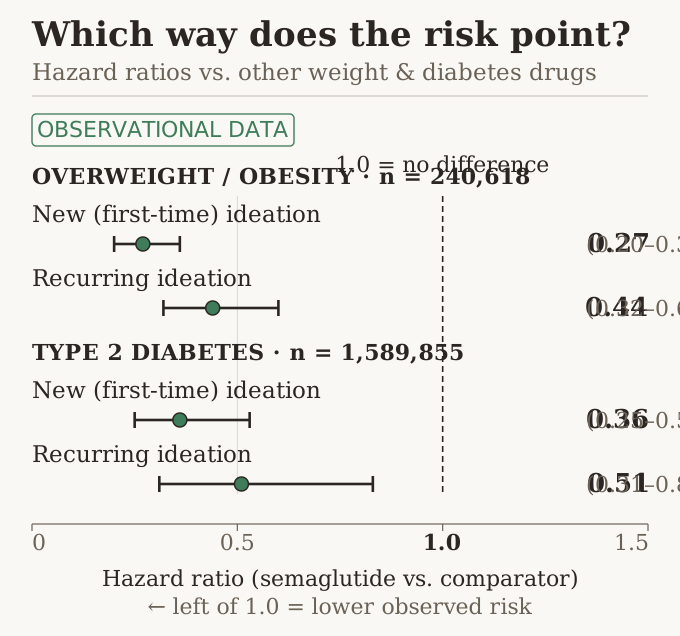
Worth knowing: the warning only ever sat on the weight-management brands (Wegovy, Zepbound, Saxenda). The diabetes versions of the same molecules — Ozempic, Mounjaro — never carried it. Same drugs; the label difference was about approved use, not a different safety finding.
So why do so many people say they feel “off”?
Here is where the honest answer stops being purely reassuring. Alongside the trial data is a growing body of anecdote — thousands of posts, and by 2026 a wave of press coverage — describing something the trials weren’t built to catch. People call it “Ozempic personality.” The descriptions rhyme: nothing brings me joy anymore. The food noise is gone, but so is everything else. My sex drive vanished. I feel flat. Some frame the very same change as a relief — a “quiet mind.”
The leading explanation is mechanistic — and still a hypothesis. GLP-1 receptors sit not just in the gut but in the brain’s reward circuitry — the dopamine-linked system that assigns wanting to things. That’s almost certainly part of why these drugs quiet the compulsive pull of food. The open question is whether, in some people, turning down that dial also mutes other appetites: for sex, for novelty, for the small daily hits of pleasure. It’s a plausible story with real biology behind it. It is not, yet, a measured or labeled effect.
A medicine strong enough to quiet the pull of food may, for some people, quiet other wanting too. Plausible biology — and, so far, unproven and unmeasured.
So we grade it plainly: the reports are real and worth taking seriously, but the evidence is anecdotal and emerging — uncounted, and unproven as to cause. It’s tempting to file “Ozempic personality” as something separate from depression — but the overlap is real. Persistent flatness, loss of interest, and low libido are also core symptoms of depression itself. The rule of thumb that actually keeps you safe is duration and company: a passing dulling that eases as your body settles is one thing; flatness that sticks, deepens, or arrives alongside hopelessness, changes in sleep or appetite, or thoughts that life isn’t worth it is another — and that second kind should be treated as depression until a clinician says otherwise, not waved off as a harmless personality quirk.
Three claims, three different grades
The reason this topic generates so much heat is that people argue three separate questions as if they were one — first, whether these drugs cause depression; second, whether they treat it; third, whether they flatten mood and libido. Pulled apart, they don’t even have the same answer.
| The claim | What the evidence says | Honest grade |
|---|---|---|
| “GLP-1s cause depression and suicidal thoughts” | 91 trials / 107,910 people show no increased risk; 2.2M-patient real-world review agrees; EMA concurs | Not supported — the strong data argue against it |
| “GLP-1s protect mood / treat depression or anxiety” | The one large cohort here measured suicidal ideation — linking semaglutide to lower rates — not depression or anxiety scores; it’s observational, and no mood use is approved | Emerging / observational — a signal, not a treatment |
| “GLP-1s can flatten mood, joy, or libido (‘Ozempic personality’)” | Consistent patient reports + a plausible reward-system mechanism; no trials measuring it | Anecdotal / emerging — real accounts, unproven and unmeasured |
Notice that the first two can both be true: a drug can fail to cause depression and even associate with less of it, while still, for a subset of people, dulling the texture of everyday wanting. Populations and individuals are different objects.
What this means if it’s you
None of the above tells you how you will feel, and the average of a hundred thousand people is cold comfort at 2 a.m. So the practical version is simpler than the science.
If your mood, motivation, or sense of pleasure shifts after starting a GLP-1 — in either direction — that is worth naming to your clinician, not something to tough out. “No increased risk across 107,910 people” and “my mood dropped and I want to talk about it” are not in conflict; the first is a population fact and the second is your data, which matters more for you. A change that feels out of proportion to what’s going on in your life, especially in the first weeks, is exactly the kind of thing to raise.
Some shifts are worth a call within days, not a wait for the next appointment. Contact your prescriber promptly if you notice hopelessness that won’t lift, loss of interest that lasts more than a couple of weeks, sleeping or eating much more or less than usual, feeling worthless, or new restless anxiety or agitation. Those are the signs that a dulling has crossed into something that deserves treatment.
If you’ve lived with depression or anxiety, that history isn’t a reason you can’t take one of these medicines — but it’s a reason to say so up front, so mood is watched from the start rather than after something slips. An active or recent eating disorder is a different conversation: because these drugs act directly on appetite and can feed restriction or purging, it’s worth asking a clinician who knows that history whether the timing is right at all — not just monitoring as you go.
And the flat, joyless version deserves its own plain sentence: for some people it eases as the body settles; for others it’s persistent enough to weigh against the benefit. That’s a real conversation to have with a prescriber, not a verdict to accept in silence.
If you're having thoughts of harming yourself, this is not something to wait on. In the U.S. you can call or text 988 (the Suicide & Crisis Lifeline) any time, or contact your local emergency number. It doesn't matter whether a medicine is "supposed" to cause it — new or worsening thoughts of self-harm are always a reason to reach out now.
The honest bottom line
The frightening headline — that these drugs drive people to suicide — did not survive contact with the biggest data we have, and the FDA’s 2026 reversal reflects that. But “not dangerous on average” was never the whole story, and the site that tells you only the reassuring half is doing the same thing as the site that tells you only the scary half: choosing a headline over you. The fuller truth is that a medicine powerful enough to quiet food noise is, unsurprisingly, powerful enough to touch other parts of how you feel — mostly not for the worse, sometimes in ways worth watching, and always worth talking about with someone who knows your history.
Sources (5)
Every claim on this page traces to a primary source — and we sell you nothing. No sponsors, no affiliate links, no ads.
- 1 meta-analyses
- 1 news / agency
- 1 observational studies
- 1 guidelines
- 1 FDA labels
More like this