Ozempic face: is it real, is it the drug or the weight loss, and is it permanent?
The short answer
"Ozempic face" is real but misnamed. It's the gaunt, hollow-cheeked, or loosened look some people notice after large, fast weight loss on a GLP-1 medicine — and the best evidence, including a 2025 systematic review, says it is facial fat and volume loss driven by the weight loss itself, not the drug chemically ageing your skin. The same change follows comparable weight loss by any route, and it happens with tirzepatide (Mounjaro/Zepbound) too — "Mounjaro face" is the same thing under a different brand. It isn't simple to reverse: some laxity settles as weight stabilises, but rapid loss in older, less elastic skin may not bounce back on its own, and regained weight rarely refills the face the way it left. The pace of loss, and protecting muscle, are the levers people actually have; any cosmetic decision belongs with a clinician.
Evidence grade
Strong evidenceRung 2 of 8 · Supported but limitedLast reviewed
The Evidence Ladder
Real human evidence, but narrow in population, use, or scale.
↑ Stronger — proven in people
- 1Established
- 2Supported but limited
- 3Emerging
- 4Observational only
- 5Preclinical
- 6Anecdotal
- 7Speculative
- 8Unsafe to state
↓ Weaker — theory only
Key takeaways
- 01It's real, but it's not the drug ageing your skin. A 2025 systematic review found no evidence that GLP-1 medicines preferentially melt facial fat — the changes are downstream of whole-body weight loss, with the face losing padding faster than skin can retract. Graded supported but limited.
- 02The drug is why the weight came off — not a separate reason the face changed. The same gaunt-or-loose look follows comparable weight loss by any route: bariatric surgery, illness, or crash dieting. You can't choose where fat leaves, and the face is one of the places it leaves from.
- 03"Mounjaro face" is the same thing. Tirzepatide (Mounjaro/Zepbound) and other GLP-1 medicines drive it too, because it tracks the amount and speed of weight loss, not the specific molecule. The branded nicknames are marketing, not different conditions.
- 04It is not cleanly "permanent" or cleanly "reversible." Some skin laxity settles as weight stabilises; significant, rapid loss in older or less elastic skin may not recover on its own, and regained weight rarely refills the face the way it left.
- 05Pace of loss and muscle are the levers you actually have. Slower loss gives skin more time to adapt, and protein plus resistance training protect lean mass. Cosmetic options exist but rest on low-quality evidence — and are a clinician's conversation, not a protocol.
On this page10 sections
- What is Ozempic face?
- Is it the drug or the weight loss?
- Does it happen with Mounjaro, Zepbound, and tirzepatide too?
- Is Ozempic face permanent?
- Can you prevent it?
- What do dermatologists actually say about treatment?
- What is unknown
- Frequently asked questions
- Questions to ask a clinician
- Red flags / when to seek care
- Sources (9)
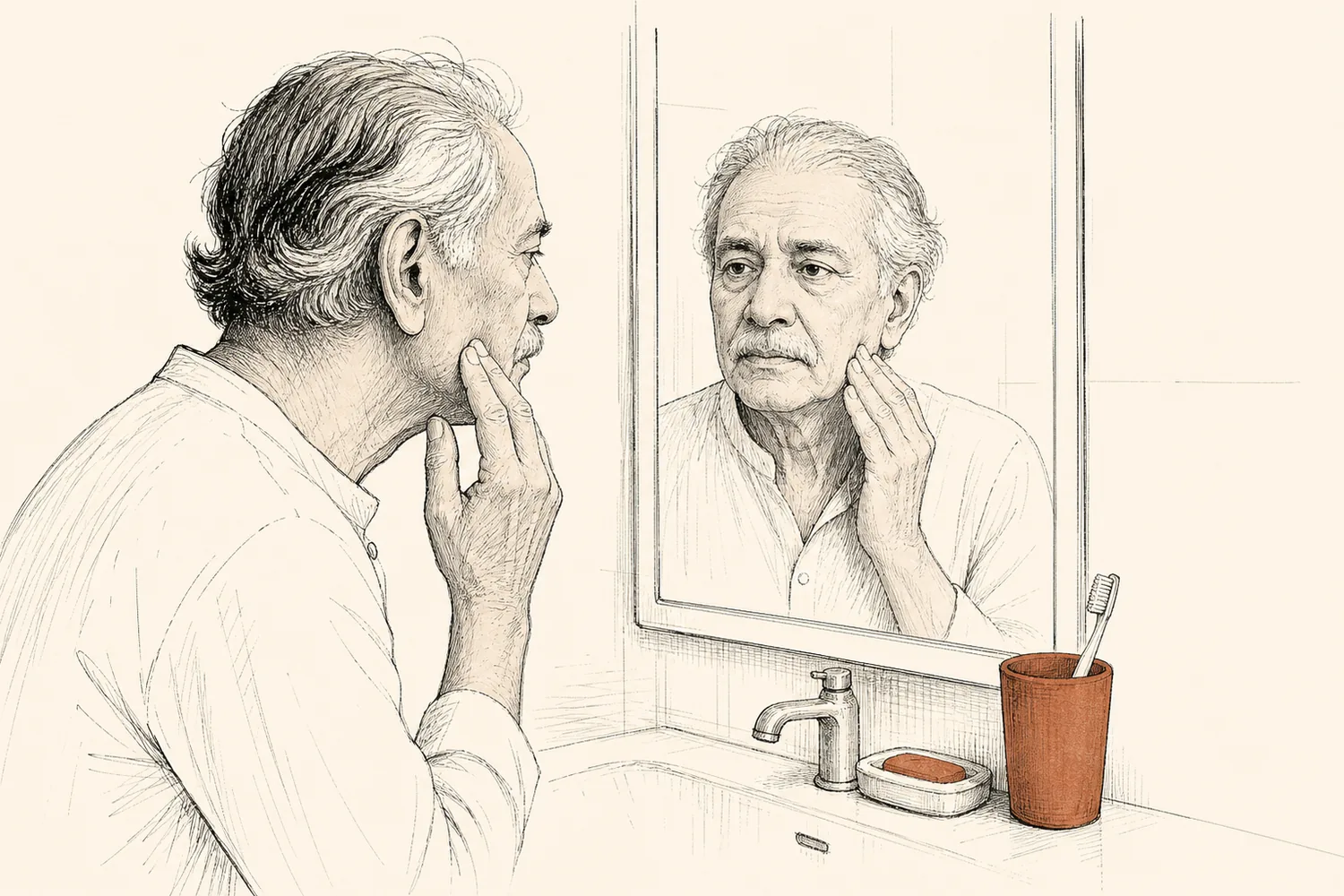
“Ozempic face” is a popular phrase, not a medical diagnosis. It describes the gaunt, hollow-cheeked, or loosened look some people notice in the mirror after losing a lot of weight quickly on a GLP-1 medicine. The name is sticky because it sounds like a toxic side effect of one drug. The evidence points somewhere calmer and more general: it is mostly what a face looks like after it loses fat. That doesn’t make it imaginary, and it doesn’t make it trivial — a face that no longer looks like yours is a real thing to grieve. It just means the honest explanation, and the honest options, are different from the scary version.
What is Ozempic face?
It’s an informal, media-coined term — attributed to a New York cosmetic dermatologist and pushed into wide use by news coverage that broke in early 2023 — for a cluster of changes in the face after rapid weight loss: hollow or flattened cheeks, temples that look sunken, deeper folds around the mouth and eyes, and skin that reads as loose or “deflated.” There is no clinical definition and no diagnostic test. It is a description of an appearance, not a disease.
Two facts sit under it, and the whole topic rests on them. First, GLP-1 and related medicines cause substantial weight loss. This is established from several large, randomised, placebo-controlled trials — semaglutide (Ozempic/Wegovy) produced a mean 14.9% weight reduction at 68 weeks in STEP 1, and the dual GIP/GLP-1 agonist tirzepatide (Mounjaro/Zepbound) produced up to about 20.9% at 72 weeks in SURMOUNT-1, versus a few percent on placebo. (The triple-receptor agent retatrutide reached roughly 24% in a phase 2 trial, but it is investigational and not FDA-approved.) Second, the face stores fat in discrete compartments — small cushions, not a uniform layer — and those cushions thin and shift as the body loses fat and as the skin ages. Less padding under thinner, older, or sun-exposed skin reads to the eye as hollowing, sagging, and new folds.
Is it the drug or the weight loss?
This is the question that actually matters, and here the evidence has firmed up. It is the weight loss.
A 2025 systematic review in Aesthetic Surgery Journal Open Forum pulled together the published literature on “Ozempic face” and reached a blunt conclusion: “Evidence to suggest that GLP-1 receptor agonists preferentially result in facial fat atrophy is lacking.” The drugs, the authors wrote, “merely emphasize the age-related gradual decrease in elastin turnover by accentuating sagging skin under a thinner bed of adipose tissue, rather than preferentially resulting in targeted facial fat atrophy.” A separate 2025 dermatology review put the same point plainly: “the medication promotes systemic fat reduction rather than directly affecting facial fat cells.”
In other words: the medicine is the reason the weight came off. It is not a separate chemical reason the face changed. When you lose weight, you don’t get to choose where the fat leaves — and the face is one of the places it leaves from. The facial change is downstream of the weight loss, not a toxin acting on your skin.
The drug is why the weight came off — not a separate reason the face changed. That distinction is the whole story: “Ozempic face” is what a face looks like after it loses fat, showing up somewhere people don’t want it.
We grade the core claim — volume loss, not drug toxicity — as supported but limited rather than established. Not because the direction is in doubt, but because the direct study of facial appearance during GLP-1 therapy specifically is still thin. The systematic review found only 23 articles, most of them opinion pieces, correspondence, and small case series, with just three controlled cohort studies. The underlying anatomy and physiology it rests on are much stronger than the drug-specific facial literature.
Does it happen with Mounjaro, Zepbound, and tirzepatide too?
Yes. “Mounjaro face” and “Zepbound face” are the same thing under different brand names. The systematic review identified the same morphological changes across semaglutide (Ozempic, Wegovy), tirzepatide (Mounjaro, Zepbound), and liraglutide (Saxenda) — and, by the same logic, across the body (“Ozempic body,” “Ozempic butt”). That is exactly what you’d expect if the mechanism is weight loss rather than a molecule-specific effect on the face. Any medicine that takes off a lot of weight quickly can do it; the branded nicknames are marketing, not different conditions. And it isn’t unique to drugs at all — the same look can follow bariatric surgery, serious illness, or crash dieting.
Is Ozempic face permanent?
This is the honest hard part: it is neither cleanly permanent nor cleanly reversible, and the answer depends mostly on your skin, your age, and how fast you lost the weight.
Younger, more elastic skin retracts better as weight stabilises, and some of the “deflated” look eases once the loss stops and the face settles. Older or sun-damaged skin has less elastic recoil, so significant, rapid loss can leave laxity that doesn’t fully bounce back on its own. And regaining weight is not a reliable fix: the systematic review notes that during weight regain, “fat distribution rarely returns to its pre-weight-loss state,” which can leave lasting changes even if the number on the scale comes back. So “permanent” overstates it and “temporary” understates it. The fair summary: partly self-correcting for some people, partly durable for others, and not something anyone can promise you in advance.
Can you prevent it?
Partly — and the levers are the same ones that protect the rest of the body during weight loss, which is why the book treats them as one story.
The two ideas with the most support behind them are both about how the weight comes off, not whether it does:
- The pace of loss. Larger, faster losses give skin less time to retract, which clinicians consistently describe as making hollowing and laxity more noticeable. This is anatomically sensible and clinically observed, though it hasn’t been tested head-to-head for the face specifically. A steadier pace is a reasonable thing to discuss with a prescriber.
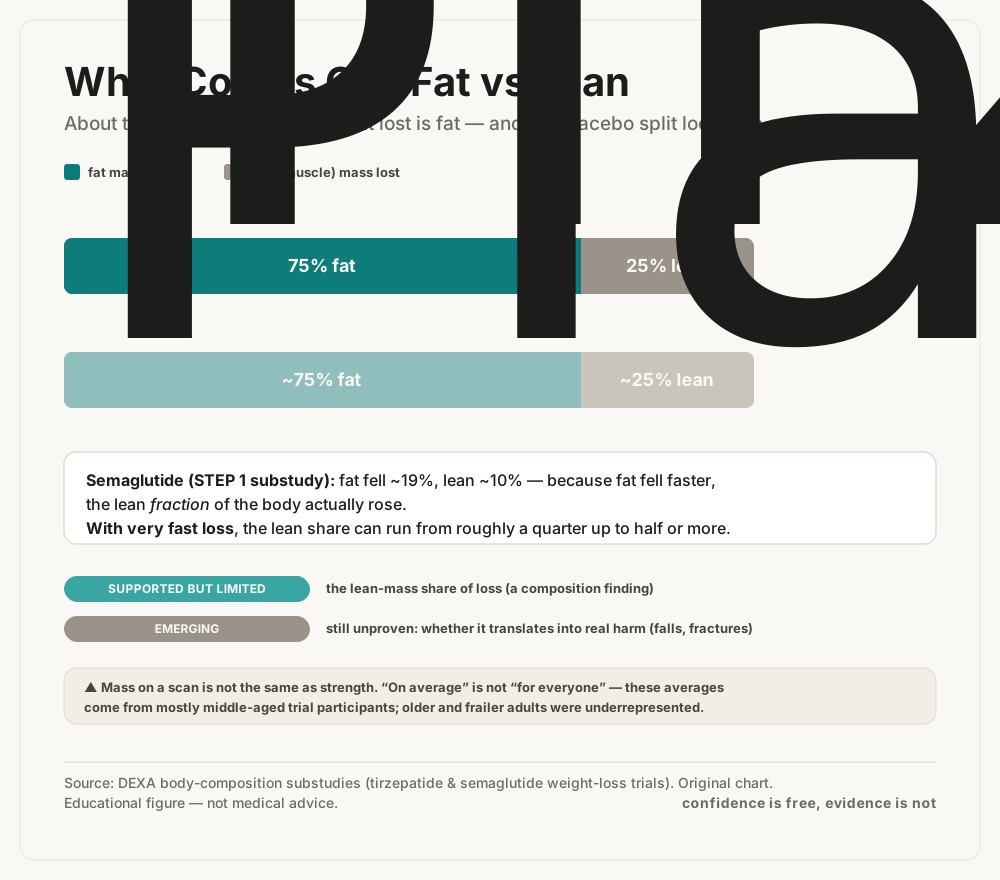
- Protecting muscle. Weight lost on these medicines isn’t pure fat: DEXA body-composition analyses put the lean-mass share of the loss somewhere between about a quarter and 40%, depending on the trial and how it’s measured — closer to a quarter in the tirzepatide (SURMOUNT-1) data, about 40% in the semaglutide STEP 1 substudy. That’s typical of any large weight loss, but still worth defending — and, especially in older adults, preserving muscle is about strength and lowering frailty risk, not just how the face looks. Enough protein plus resistance training is the well-established way to hold onto lean mass, and it helps the whole frame — including the face — look less “collapsed.”
Skincare marketing pushes retinoids, vitamin C, peptides, and collagen supplements as prevention. Dermatology reviews do mention collagen-supporting skincare as a plausible adjunct — but be clear-eyed: controlled evidence that any topical or supplement measurably prevents this facial change during weight loss does not yet exist. It’s a reasonable hope, not a proven shield.
What do dermatologists actually say about treatment?
The dermatology and plastic-surgery literature describes a familiar menu of cosmetic options — and is candid that the evidence behind them, for this specific use, is mostly experience and case series rather than controlled trials. This is a description of what the field discusses, not a recommendation or a plan; what’s right for any individual is a conversation with a qualified clinician.
- Volume replacement. Injectable dermal fillers are the most-discussed option for restoring lost facial volume. Biostimulatory injectables (collagen stimulators) are used with the same intent — notably, one such product was originally FDA-approved for HIV-associated facial fat loss, an analogous “shrunken cushions, intact skin” situation.
- Skin tightening. Energy-based treatments such as radiofrequency microneedling and laser therapy are described for laxity and skin quality.
- Surgery. For significant, stable laxity, face- or neck-lift procedures and fat grafting are discussed. The systematic review’s practical note on timing is worth repeating: surgeons generally want weight to be stable first — “ideally…at least 6 months of stable weight before surgery,” given that weight loss on these medicines peaks around a year in.
The through-line is that these address the appearance of volume loss; none of them changes the fact that the underlying driver was weight loss. And every one carries cost, trade-offs, and its own risks — reasons the choice belongs with a clinician, not a social-media before-and-after.
What is unknown
- Whether, gram for gram of weight lost, GLP-1 medicines change the face any differently than other routes to the same weight loss. No direct comparison exists.
- How much of any individual’s change is fat loss versus skin quality, age, sun history, genetics, and baseline face shape — these are tangled together in every person.
- Whether slowing the rate of loss, or any specific nutrition or training strategy, measurably protects facial appearance. It’s reasonable to expect, but it hasn’t been tested for the face.
- The long-term course: how much hollowing settles, persists, or partly recovers over years, and how much of the cosmetic-treatment enthusiasm will survive controlled study.
Frequently asked questions
Is Ozempic face real? Yes — the facial change is real, but the name is misleading. It describes hollow cheeks, sunken temples, deeper folds, and looser skin that some people notice after fast, substantial weight loss on a GLP-1 medicine. A 2025 systematic review concluded there is no evidence the drugs preferentially strip facial fat; the changes are downstream of whole-body weight loss, so the same look can follow any large weight loss, including bariatric surgery or crash dieting.
Does Ozempic actually age your face, or is it just weight loss? It’s the weight loss. Dermatology and plastic-surgery reviews find the medicine drives systemic fat reduction rather than acting directly on facial fat or skin. The face loses some of its fat padding along with the rest of the body, and thinner skin over less cushion reads as “older.” The drug is the reason the weight came off, not a separate reason the skin aged.
Is Ozempic face permanent? Not cleanly either way. Some laxity settles once weight stabilises, especially in younger, more elastic skin; significant, rapid loss in older or sun-damaged skin may not fully recover on its own. Regaining weight is an unreliable fix, because fat rarely returns to the face the way it left. How durable it is depends on age, skin quality, and how fast the weight came off.
Does Mounjaro or Zepbound cause the same thing? Yes. “Mounjaro face” and “Zepbound face” are the same phenomenon under different brand names — tirzepatide, semaglutide, and other weight-loss medicines all do it, because it tracks the amount and speed of weight loss rather than the specific drug.
Can you prevent Ozempic face? There’s no proven way to prevent it, but two levers have the most support: losing weight at a steadier pace (giving skin more time to adapt) and protecting muscle with enough protein and resistance training. Collagen-supporting skincare is often marketed for prevention, but controlled evidence that it prevents this specific change does not yet exist.
Do fillers fix Ozempic face? Dermatologists describe injectable fillers and collagen-stimulating injectables as the most common options for restoring lost facial volume, along with skin-tightening treatments and, for major laxity, surgery. The evidence for these in this specific setting is mostly clinical experience and case series, and all carry cost and trade-offs — which is why the decision belongs with a qualified clinician, not a before-and-after photo.
Questions to ask a clinician
- Is the rate of my weight loss reasonable, or fast enough that I should consider slowing it to protect muscle and skin?
- Am I getting enough protein, and should resistance training be part of my plan to preserve lean mass?
- Are the facial changes I’m seeing consistent with normal volume loss, or is there anything here that needs a closer look?
- If the appearance bothers me, what are the evidence-based options — and what are their trade-offs, risks, and costs?
Red flags / when to seek care
“Ozempic face” itself is a cosmetic, not a medical, problem. But some things that can show up during rapid weight loss are not cosmetic and deserve prompt attention:
- Facial changes arriving with dizziness, fainting, a racing heart, or new weakness — possible signs of dehydration or losing weight too fast.
- Sudden, asymmetric facial drooping, slurred speech, or one-sided numbness — these are stroke warning signs, not weight-loss effects; call your local emergency number immediately.
- New facial swelling, hives, lip or tongue swelling, or trouble breathing after a dose — seek emergency care for a possible allergic reaction.
- Weight loss that feels uncontrolled or accompanied by feeling unwell, rather than gradual and planned.
The face in the mirror is real, and it is fair to mind how you look. But the honest version of this story is undramatic: lose a meaningful amount of weight by any means, and the face loses some of its padding. The drug is the reason the weight came off — not a separate reason the face changed.
Sources (9)
Every claim on this page traces to a primary source — and we sell you nothing. No sponsors, no affiliate links, no ads.
- 4 randomized trials
- 2 reviews
- 2 other primary
- 1 observational studies