Living with it
GLP-1s and exercise: why resistance training earns its place
GLP-1s and exercise: why resistance training earns its place
Fast weight loss always sheds some muscle with the fat. Lifting things — not the medicine — is what protects it. Here's what the evidence actually supports, framed as a floor, not a workout plan.
Here’s a fact that doesn’t fit the marketing: when you lose weight quickly, some of what leaves is muscle. Not just fat — muscle, and the lean tissue around it. This is true of dieting, of weight-loss surgery, and of GLP-1 medicines. It’s a feature of losing weight itself, not a special flaw in any one drug. And the medicine, for all it does to your appetite, does nothing to protect the muscle you’d rather keep.
That job falls to you, and to two unglamorous levers: enough protein, and resistance training. This article is about the second one — why lifting things earns its place during rapid weight loss, exactly how strong that evidence is, and how to think about it as a floor rather than a program.
What actually protects muscle
Start with the cleanest evidence, because it’s genuinely good. In a randomized trial of older adults losing weight, the people assigned to resistance training held onto meaningfully more lean mass than those who dieted with aerobic exercise alone — and the group doing both resistance and aerobic work improved their physical function the most. In numbers: lean mass fell about 2% with resistance training and 3% with combined training, versus 5% with aerobic exercise alone. Same weight loss; different amount of muscle walking out the door.
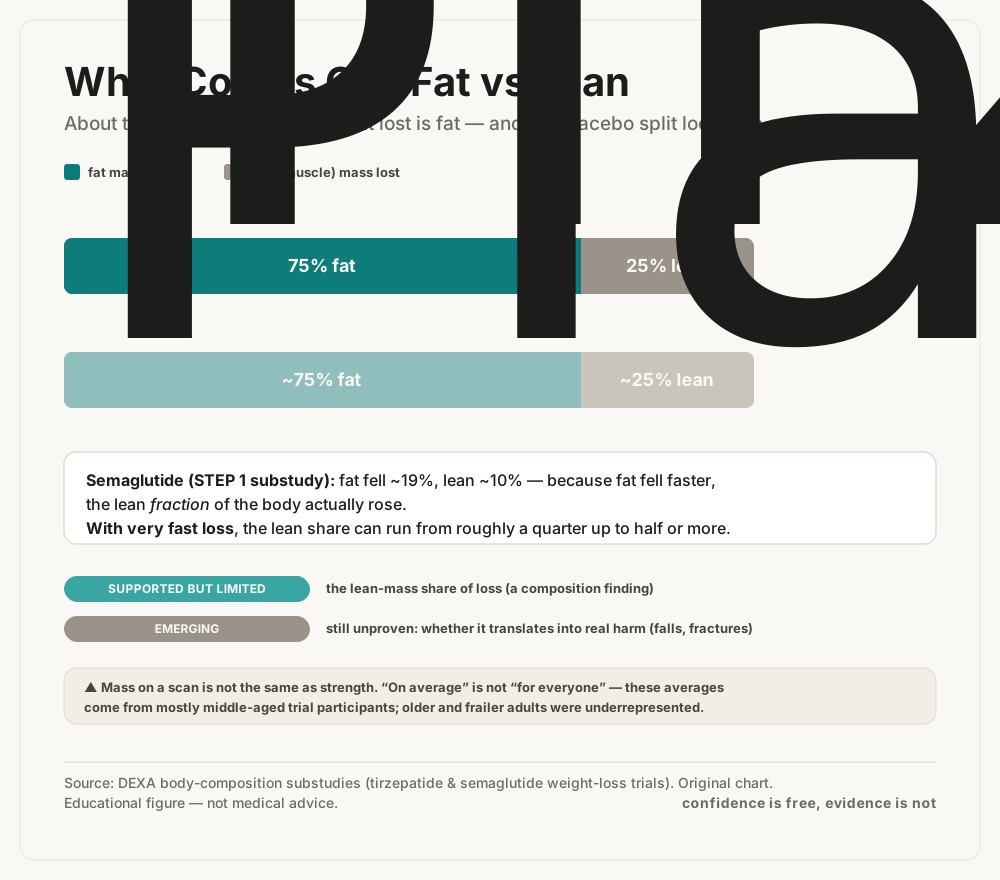
Same weight loss, different amount of muscle walking out the door. The medicine doesn’t decide which — you do.
That’s an RCT, which is why we’ll say it plainly: resistance training preserves lean mass during weight loss is well-supported. What’s more limited is the GLP-1-specific version of the claim — the studies designed to measure exactly this in people losing weight on semaglutide or tirzepatide are still thin. So the honest grade for “lift weights while you’re on a GLP-1 and you’ll protect muscle” is supported but limited: strong general evidence, extrapolated to a newer situation, not yet nailed down head-to-head. We lay out the full picture, including what’s still unknown, on our muscle-loss page.
There’s one trial that gets closer. When researchers took people who’d already lost weight and randomly assigned them to structured exercise, a GLP-1 medicine (liraglutide), both, or neither, the combination protected body composition and kept the weight off better than either alone — and cut body-fat percentage about twice as much as either single approach. The lesson isn’t that the drug failed. It’s that the exercise was a deliberate, programmed input — not something the weight loss produced on its own. On these medicines, the moving-more doesn’t arrive by itself. You add it on purpose.
Why protein and lifting go together
Muscle is built and defended by two things working as a pair: the raw material (protein) and the signal to keep it (loading your muscles). Do the training without enough protein and you’re asking your body to maintain a building without delivering bricks. Get the protein but never challenge the muscle and you’ve delivered bricks with no reason to build. On a GLP-1, both halves get harder — the appetite suppression that drives the weight loss also makes it easy to under-eat protein, and the reduced fuel can sap the drive to train. Which is exactly why they’re worth being intentional about, together, rather than hoping they happen.
We keep the protein specifics — how much, and how to hit it when you’re barely hungry — with your clinician and our separate protein tools, because the right target depends on your age, kidneys, and starting point. This piece stays in its lane: the case for lifting.
“Minimum effective,” not “no pain, no gain”
The mistake people make here is imagining resistance training means a gym membership, a barbell, and an hour you don’t have. It doesn’t. The public-health guidelines that underpin all of this ask for muscle-strengthening activity on two or more days a week, alongside regular aerobic movement — a floor most people can hit with bodyweight moves, resistance bands, or a couple of dumbbells at home. The point of “minimum effective” is that the first, hardest gap to close is from zero to something. That gap is where most of the benefit lives.
Think of it as a floor you’re trying not to fall through, not a peak you have to summit. Consistency beats intensity here. Two honest sessions a week that you actually do, for months, will protect more muscle than an ambitious five-day plan you abandon in a fortnight.
The part that’s a clinician conversation
We’re deliberately not handing you a workout. That’s not caution theater — it’s because the right starting point genuinely depends on things we can’t see from here. If you have heart disease, uncontrolled blood pressure, joint problems, a history of falls, or you’re older or frailer, the sensible first move is to ask your clinician what’s safe to start, and whether a physical therapist or qualified trainer should set up your first few sessions. That conversation is especially worth having on a GLP-1, because you may be eating much less than you used to, and starting hard exercise on low fuel is its own risk.
A few things are always worth flagging to a professional rather than pushing through: feeling dizzy, faint, or wiped out during activity; getting weaker rather than steadier over a few weeks; or exercise starting to feel like a punishment for eating. Those aren’t discipline. They’re signals.
If you want a structured, general starting frame — not a prescription — our Strength Minimum Plan walks through the “minimum effective” idea in more detail. But the one-sentence version is the one worth keeping: the medicine handles your appetite; protecting your muscle is the part you keep, and lifting is how you keep it.
Sources (3)
Sourced, and we sell you nothing — no sponsors, affiliates, or ads.
- Villareal DT et al. Aerobic or Resistance Exercise, or Both, in Dieting Obese Older Adults. N Engl J Med. 2017;376:1943–1955. RCT
- Lundgren JR et al. Healthy Weight Loss Maintenance with Exercise, Liraglutide, or Both Combined. N Engl J Med. 2021;384:1719–1730. RCT
- Piercy KL et al. The Physical Activity Guidelines for Americans. JAMA. 2018;320(19):2020–2028. GUIDELINE
More like this